As an Amazon Associate, I earn from qualifying purchases with no additional costs for you.
Florida is a state that many rockhounders would assume has little of interest to find in, given its generally extremely flat topography, but there are actually an unexpected number of fantastic places in the state to search for rocks, minerals, and fossils.
Florida’s physical geography consists of flat plains in the south of the state, gently rolling hills in the northern part, and the panhandle. Considering this, the geology of Florida makes it better suited to fossil hunting than to finding rocks and minerals. With its famously good weather, the state of Florida is a good place to rockhound year-round.
The Best Rockhounding Spots in Florida are:
| Site | Public or Private | GPS Coordinates |
|---|---|---|
| Caladesi Island | Public | 28.029044, -82.820487 |
| Crystal River | Public | 28.905825, -82.628306 |
| Vero Beach | Public | 27.643667, -80.352421 |
| Peace River | Public | 27.233998, -81.888520 |
| Venice Beach | Public | 27.101633, -82.460947 |
| Fossil Expeditions | Private | |
| Paleo Discoveries | Private | |
| Bone Valley Fossil Farm | Private | |
| Ruck’s Pit | Private | 27.510981, -80.769875 |
| Amelia Island | Public | 30.687527, -81.428064 |
Some of the rocks and minerals you can find in Florida are agatized coral, chalcedony, geodes, chert, and fossils of coral, coquina, shells, shark teeth, sponges, and manatee bones.

If you want to check out the best rockhounding tools, you can find them by clicking here (Amazon link).
Rockhounding Regulations and Laws in Florida
Rockhounding on federal tracts of land (national parks and the Bureau of Land Management) is generally allowed. State parks in Florida usually do not permit the collection of rocks, minerals, and fossils from their lands.
As the rules regarding rockhounding on public and private lands are always changing, be sure to check with the state parks or landowners before you head out to new sites on your rockhounding adventures.
The rules regarding rock and fossil hunting in Florida can be found here. A permit is required for collecting fossils from vertebrates (apart from shark teeth). The permit costs $5 and is valid for one year.
The Best Public Rockhounding Sites in Florida
You can find some of the best public rockhounding sites in Florida below.
Caladesi and Honeymoon Islands
Caladesi Island is a beautiful place to rockhound, both on the island itself and the causeway that connects it to the mainland. In 1921, a hurricane created a channel that separated Caladesi Island from Honeymoon Island.
The islands are an excellent place to rockhound, as there are diverse geologic formations there that the explorer can gather material from. The shorelines of these islands have plenty of fossils, rocks, and shells to collect.
The Hawthorn Formation lies under these islands, which is a layer of clay, marl, sand, and limestone. In most parts of the state, this formation is buried under sand, but it comes to the surface at these islands. It is from this layer that most of the fossils found here originate. The easy access to these beaches makes this a good place to take the family on a fun day out.
| Rocks / Minerals | Rarity |
|---|---|
| Fossils | Occasional |
| Agate | Occasional |
| Calcite | Occasional |
Crystal River
The Crystal River is an area of exceptional natural beauty, making it an appealing site to find fossils while enjoying the natural setting. Many types of marine fossils can be found here. While fossils are the main attraction, some interesting specimens of rocks and minerals can be found here as well, in particular calcite and quartz.
Good rockhounding can be done along the water’s shores or while snorkelling or scuba diving in the river. This is another excellent place to take the family and friends on a day excursion.
| Rocks / Minerals | Rarity |
|---|---|
| Fossils | Common |
| Calcite | Occasional |
| Druzy quartz | Occasional |
| Chert | Occasional |
BTW: Do you want to know more about rock and mineral identification? The books listed below are the best ones you can find on the internet (Amazon links):
- Smithsonian Handbooks: Rocks & Minerals
- Gemstone & Crystal Properties (Quick Study Home)
- Ultimate Explorer Field Guide: Rocks and Minerals (National Geographic Kids)
Vero Beach
Situated on the east coast of Florida, the shoreline of Vero Beach can be a fantastic place to rockhound and beach comb, where the rockhounder can find shark teeth and other marine fossils. The best times to search for rocks and fossils here are after storms and high tides, after the large waves have exposed more material for the rock and fossil hunter.
In addition to fossils and rocks, there is ample opportunity here for the seashore explorer to find nice shells. In addition to rock and fossil hunting on the shoreline, there are interesting limestone outcrops to be explored inland from the beach.
| Rocks / Minerals | Rarity |
|---|---|
| Fossils | Common |
| Calcite | Occasional |
| Quartz | Occasional |
Peace River
The Peace River offers some excellent spots for fossil hunting. Fossils can be found all along the river, with the best places to look being the submerged gravel banks along the water’s edge when the water levels are low; the best time of year for low water is during Florida’s dry season, which is approximately October through April.
The tools suggested for looking for fossils in the Peace River are a shovel and a sifter. A kayak or canoe can make finding suitable sites easier. You can find more information about fossil hunting on the Peace River here.
| Rocks / Minerals | Rarity |
|---|---|
| Fossil shark teeth | Common |
| Fossil ray teeth | Occasional |
| Mastodon teeth | Rare |
| Alligator and Crocodile Teeth | Occasional |
| Fossil mammal bones | Occasional |
Venice Beach
Venice Beach is one of the best places in the world to find shark teeth. While most of the teeth found on these beaches are under three-quarters of an inch, occasional larger ones can be found on the sand. Larger teeth can often be found a bit offshore using scuba gear.
| Rocks / Minerals | Rarity |
|---|---|
| Fossil shark teeth | Common |
Amelia Island

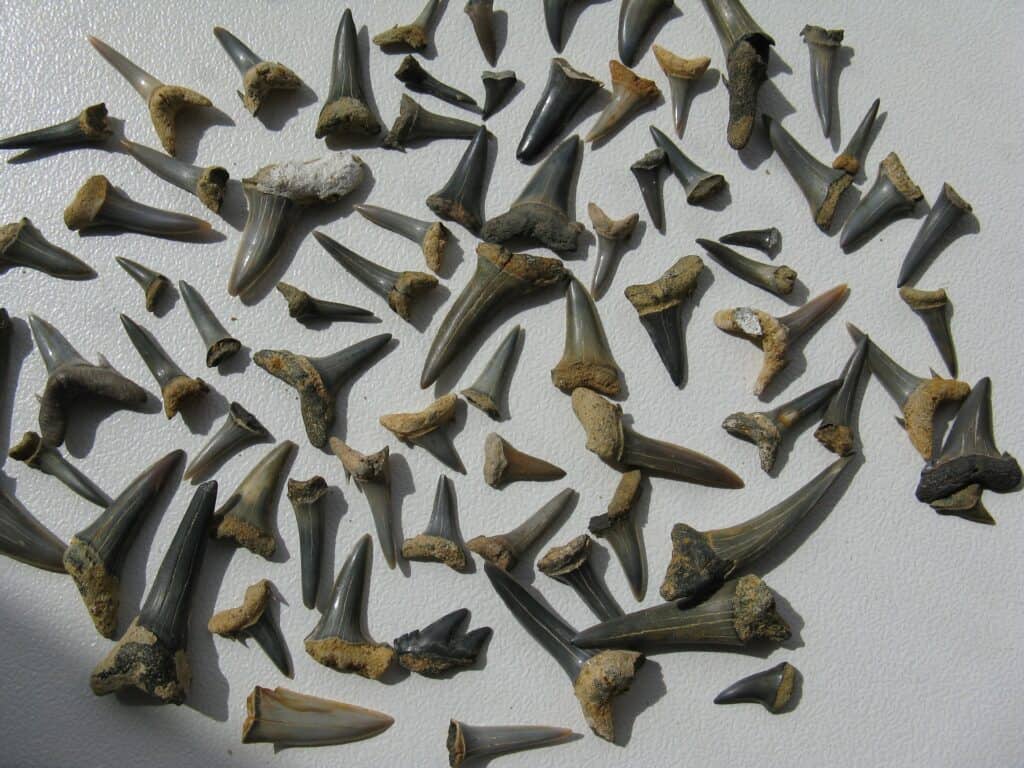
Amelia Island is located in the extreme northeast of the state, a very short distance from the border with Georgia, and is an excellent place to find fossil shark teeth. While the fossil teeth can be found on all the beaches of Amelia Island, some places are more productive than others.
In particular, the beaches of Fort Clinch State Park offer more teeth than the other beaches on the island. This is due to the fossils being brought to the beach by currents flowing from the St. Marys River.
This river inlet is kept open by regular dredging, and the sand brought up by the dredging is perhaps the best place to look for fossil shark teeth. The best time to look for fossils is at low tide. Collecting fossils and shells is permitted in the park.
TIP: Fossils of Florida’s famous shark teeth are great to find, especially when you are looking for gemstones with kids. Learn more about how to get kids started with rockhounding in this article:
Rock Collecting for Kids: How to Get Them Started
Best Pay to Dig Sites for Rockhounds in Florida
If you’re looking for a guided experience, consider visiting a place that offers instruction and tools, such as these locations that offer guided fossil hunting excursions and activities.
Fossil Expeditions
Located on the Peace River between Arcadia and Wauchula, Fossil Expeditions offers fossil hunting excursions both by foot and by kayak. Some of the fossils that can be found on these expeditions are shark teeth, mammal bones, reptile bones, and teeth. Fossil Expeditions takes clients to a variety of fossil-finding sites, which change periodically.
The walk-in trips cost $75 per adult and $50 for kids twelve and under. This expedition is not recommended for children under five. The kayak trips cost $100 per adult and $65 for children between six and twelve. This expedition is not suitable for those under six years of age.
Paleo Discoveries
Paleo Discoveries takes participants to fossil sites by canoe to less-visited locations on the Peace River, about an hour east of Sarasota. The cost for the trip is $125 per person; kids under 12 cost $90 each. Paleo Discoveries provides the requisite fossil hunting equipment and permits.
Fossils from sharks, whales, dolphins, fish, sabre-tooth cats, mammoths, and many other types can be found at these sites. Paleo Discoveries also has an online store where you can buy gift certificates for your fossil-loving friends and family.
Bone Valley Fossil Farm
Located in the central Florida phosphate district, which is also known as Bone Valley due to the many fossils that can be found in this part of the state. The site is located in Bowling Green. The site provides material to be wet screened to find the fossils within it.
The charge for each adult is $220. Children 17 and under are free and must be accompanied by an adult. The tools needed to screen for fossils will be provided. Fossils that can be found here include many types of shark, rays, fish, alligator, dolphin, turtle, mammoth, and horse.
Ruck’s Pit
Situated in Okeechobee, Ruck’s Pit is a former mining site dating to the early 1900s, now used as a place to hunt for fossils. This site is part of the Fort Drum Crystal Mine. The original mine pits have flooded, and the collecting site is now done with screens on material from the mines that has been brought to a campsite to be sifted.
Among the exciting things to find are hand-sized fossil clams filled with calcite crystals. The fee to dig is $100 per day, and camping is available at $25 per night. The site is said to be run down, but the main interest is in the sands and the fossils they contain. The fossils that can be found here are estimated to be about 1.5 million years old.
TIP: Beaches in Florida are great places for rockhoudning. Find out the common rocks you can find on beaches in the article below:
25 Most Common Rocks on the Beach: How & Where to Find Them?
Other Notable Rockhounding Spots in Florida
Spots in Northern Florida
Here are some additional rockhounding locations that can be found in northern Florida.
| Site | Public / Pay | GPS Location | Common Rocks / Minerals |
|---|---|---|---|
| Suwannee River | Public | 30.343083, -82.798223 | Agatised coral |
| St. Johns County Beaches | Public | 29.86478, -81.268026 | Coquina |
| Hillsborough River | Public | 28.032083, -82.381012 | Fossil coral, agate |
| Dunedin | Public | 28.066630, -82.833696 | Coral geodes |
| Stephen Foster State Park | Public | 30.331978, -82.763991 | Agatised coral |
| Skinner Mine | Public | 30.338365, -81.553443 | Ilmenite, rutile |
| Highland Mine | Public | 30.053030, -82.051278 | Kyanite, ilmenite |
Spots in Central Florida
Here are some additional rockhounding locations that can be found in central Florida.
| Site | Public / Pay | GPS Location | Common Rocks / Minerals |
|---|---|---|---|
| Polk County Quarries | Public | 27.911605, -81506701 | Fossils, petrified wood, vivianite |
| Bradford county quarries and readouts | Public | 28.819082, -82.482177 | Chert, fossil ivory |
| Crystal River | Public | 28.964204, -82.635154 | Calcite crystals, druzy quartz, chert, fossils |
| Brooksville area quarries and road cuts | Public | 28.574502, -82.425455 | Calcite, echinoid geodes, fossil coral |
| Hillsborough River banks and gravels | Public | 28.032089, -82.381081 | Fossil coral, agate |
| Pasco County river and stream banks | Public | 28.364559, -82.455558 | Fossil coral |
Spots in Southern Florida
Here are some additional rockhounding locations that can be found in southern Florida.
| Site | Public / Pay | GPS Location | Common Rocks / Minerals |
|---|---|---|---|
| Key Largo | Public | 25.110095, -80.422844 | Fossil coral |
| Englewood Beach | Public | 26.924196, -82.361444 | Fossil coral, shark teeth, sponges, manatee bones |
| Blowing Rocks Preserve | Public | 26.983917, -80.087356 | Coquina |
| Miami quarries | Public | 25.703255, -80.490924 | Oolitic limestone |
| Fossil coral, shark teeth | Public | 26.395809, -81.839527 | Ochre |
| Gulf beaches | Public | 25.941111, -81.740280 | Fossil coral, shark te |
Spots in Western Florida (panhandle)
Here are some additional rockhounding locations that can be found in the Florida panhandle.
| Site | Public / Pay | GPS Location | Common Rocks / Minerals |
|---|---|---|---|
| Washington County stream banks and roadcuts | Public | 30.563856, -85.630854 | Chert, flint |
| Chipley area limestone exposures | Public | 30.779539, -85.538430 | Calcite, chalk, chert |
| Cottondale | Public | 30.829055, -85.401834 | Red fossiliferous chert |
| Jackson County quarries | Public | 30.805071, -85.259089 | Chert, fossils |
| Quincy mines | Public | 30.676585, -84.556556 | Petrified wood, fossils |
TIP: Hunting for rocks at the seaside is a pleasurable pastime, and many treasures can be found. Find out the complete guide on how to clean beach rocks in the article below:
Cleaning Rocks From the Beach: 7 Ways How to Do It Properly
Rockhounding Clubs in Florida
Florida has a few rockhounding and fossil-finding clubs; here are some of them. These clubs are excellent places to find new rockhounding friends, and they have a wealth of information about good sites to explore that they can share with new members.
Central Florida Mineral & Gem Society
The Central Florida Mineral & Gem Society was founded in 1961 and is based in Orlando. The society is dedicated to sharing knowledge and enjoyment of gemstones, lapidary arts, minerals, and rocks. The society has a workshop, regular meetings, and periodic mineral, gem, bead, and fossil shows. Membership in the society costs $20 for adults and $10 for kids 12 – 18. You can find their website here.
Gainesville Gem and Mineral Society
The Gainesville Gem and Mineral Society is a society focused on collecting, observing, studying, preserving, and sharing fossils, gemstones, jewellery, minerals, and rocks. The society offers members regular meetings, demonstrations, field trips, lectures, and auctions. The website of the society can be found here.
Withlacoochee Rockhound Club
The Withlacoochee Rockhound Club is based in Hernando County, with meetings held in Spring Hill. The club offers regular meetings with guest speakers, videos, slide shows, demonstrations, classes, field trips, a gem and mineral show, auctions, and more. Individual club memberships run $35, and memberships for those 18 and under are $5. Their website can be found here.
The Fossil Club of Lee County
The Fossil Club of Lee County is a club for people who are interested in the fossils that can be found in southern Florida and other places. Membership in the club is $20. The club takes the occasional field trip to fossil collection sites as well as trips to museums and fossil collections. Their website can be found here.
The Florida Paleontological Society
According to the Florida Paleontological Society’s website, “The purposes of this corporation shall be to advance the science of palaeontology, especially in Florida, to disseminate knowledge of this subject and to facilitate cooperation of all persons concerned with the history, stratigraphy, evolution, ecology, anatomy, and taxonomy of Florida’s past fauna and flora. The corporation shall also be concerned with the collection and preservation of Florida’s fossils”. Their website can be found here.
Florida Fossil Hunters
According to their website, Florida Fossil Hunters is a fun and educational group with the aim of furthering understanding of the prehistory of Florida. The club offers monthly meetings held in the Orlando Science Centre, field trips, fossil swaps, and a fossil fair. The goal of the society is to promote Florida palaeontology via education. Memberships cost $20 for an individual and $25 for a family membership. You can find their website here.
State Gem, Rock, and Fossil


The state rock is also the state fossil of Florida, which is agatized coral. This rock is formed when silica replaces the original aragonite of the coral skeleton. This produces the quartz mineral known as chalcedony. This process can take many millions of years to happen. The result of this mineral replacement is known as a pseudomorph. Agatized coral was designated the state rock of Florida in 1979.


The state gem of Florida is moonstone, which is an interesting choice since there are no natural occurrences of moonstone in Florida. In 1970, Florida designated moonstone to be its state gem in commemoration of the moon landings and other space expeditions launched from Florida.
Recommended Rockhounding Gear
While special gear is not required to find nice rocks and fossils, having the right tools will help you find more than what’s simply laying around on the open ground. Here are some of the more basic tools and safety gear for interested rockhounds.
Geological Hammer
This 22oz Pointed-Tip Rock Pick by Estwing (Amazon link) is recommended for its durability and shock-reducing grip.
A rock pick is essential when collecting mineral specimens from a hard substrate such as stone. The pick’s handle is shock-resistant, making it more comfortable for use for longer times in the field.
Geology Pick
The Geology pick by Estwing (Amazon link) is a good choice for those starting out in the hobby as well as seasoned professionals.
The hammer comes with a pointed tip on one side of the head and a chiseled end on the other. This pick is good for excavating interesting mineral and fossil specimens.
Mini Shovel
The Mini D-Handle Round Point Shovel by Stanley (Amazon link) pairs convenience with durability. Especially in areas of soft material such as sand or clay, it is nice to have a sturdy shovel that is easy to carry.
The D-shaped handle gives you more leverage when digging on your knees, which is something that similarly sized standard-handled shovels wouldn’t provide.
Heavy Duty Work Gloves by Ironclad
Working with your hands in rockhounding environments can be rough; it is easy to get cuts or abrasions when in the field. Protecting your hands is important, especially while working with sharp or abrasive rocks.
The Heavy Duty Work Gloves by Ironclad (Amazon link) protect your hands from sharp rocks and tools. They are machine washable, highly abrasion resistant, and durable.
Safety Glasses
Eye protection is a must when breaking up a rock or any sort of work where debris could cause injury to your eyes.
The 3M Safety Glasses (Amazon link) are anti-fog and have a corded earplug system, as well as a removable foam gasket. The clear, scratch-resistant lenses shield the eyes against harmful ultraviolet light as well as prevent eye injury from flying rock chips.
First Aid Kit
With its 299 pieces, the Only Emergency First Aid Kit (Amazon link) is a good one for rockhounds. Of course, it’s best to avoid injuring yourself but if things go wrong it’s good to be prepared.
Some of the items found in the kit include fabric and plastic bandages, painkillers, gauze and pads, cold packs, wound closers, and many more.
Conclusion
Despite its undeserved reputation as a place of little rockhounding interest, there are still plenty of good places to hunt for rocks, minerals, gems, and fossils in the state of Florida. There is much more to the geology of Florida than the casual observer would take note of!
There are a fair number of rockhounding and fossil-finding clubs in the state, and many of them host annual fairs. Many of the sites mentioned in this article are fairly easy to get to, which makes them more accessible to people of most ages and fitness levels.
If you’re new to rockhounding and are unsure of how to start, an excellent place to begin is by contacting one of the rockhounding or fossil societies mentioned above, as these can be fantastic places to get information on where and how to rockhound in your local area. So whether you are an experienced rockhounder or if you are brand new to the hobby, Florida has a lot to offer!
TIP: To have a fun and fulfilling rockhounding experience in Florida, it’s best to gather some information about the state’s geology before you arrive:
8 Common Rocks & Minerals You Can Find in Florida