As an Amazon Associate, I earn from qualifying purchases with no additional costs for you.
Georgia is a state with a rich natural history and complex geology, which makes it an excellent place to search for nice specimens of rocks and minerals, of which there are a lot to find. Most of the best states are clustered in the northern part of Georgia, where the Appalachian Mountains reach into the state.
The Best Rockhounding Spots in Georgia Are:
| Site | Public or Private | GPS Coordinates |
|---|---|---|
| Graves Mountain Mine | Private | 33.741113, -82.527435 |
| Hogg Mine | Private | 32.990702, -85.029827 |
| Jackson Crossroads Amethyst Mine | Private | 33.885058, -82.854753 |
| Chattahoochee-Oconee National Forest | Public | 34.741786, -83.774166 |
| Sharp Top Mountain | Public | 34.26203, -84.7216 |
| Tallulah Falls | Public | 34.742645, -83.39651 |
| Villa Rica Mine | Public | 33.75921, -84.89859 |
In Georgia, you can find a wide variety of nice rock and mineral specimens, including ruby, quartz, amethyst, staurolite, topaz, moonstone, garnet, and diamond.

If you want to check out the best rockhounding tools, you can find them here (Amazon link).
Rockhounding Regulations and Laws in Georgia
Rockhounding on federal tracts of land (those managed by the Bureau of Land Management) is allowed. Some state parks permit the collection of rocks, minerals, and fossils from their lands.
As the rules regarding rockhounding on public and private lands are always changing and differ from place to place, be sure to check with the individual state parks or landowners before you head out to new sites on your rockhounding adventures.
The Best Public Rockhounding Sites in Georgia
You can find the best rockhounding sites in Georgia that are open to the public below.
Chattahoochee-Oconee National Forest
The Chattahoochee-Oconee National Forest permits the collection of rocks, minerals, and fossils within its boundaries, provided certain conditions are met. No special permissions, permits, or fees are required.
You are only allowed to collect specimens for your own personal enjoyment; commercial collecting is not allowed. No mechanical equipment is permitted to be used. You can collect up to ten pounds of material. Specimens can be collected if you can see some or all of the specimens exposed above the surface of the ground.
You can find rocks and minerals of igneous, sedimentary, and metamorphic origin in this national forest. Gold panning is permitted in most stream beds as long as significant stream disturbance is not allowed to happen. Further information can be found here.
| Rocks / Minerals | Rarity |
|---|---|
| Petrified wood | Occasional |
| Chalcedony | Occasional |
| Chert | Common |
| Flint | Common |
| Jasper | Common |
| Opal | Rare |
| Quartz | Common |
| Selenite | Occasional |
Sharp Top Mountain
Situated in the beautiful Chattahoochee National Forest, Sharp Top Mountain is a good place to find crystals of staurolite, which formed in the metamorphic rock schist that the mountain is made of. In addition to finding staurolite crystals, the natural setting is charmingly lovely, and this is a fantastic place to enjoy nature as you rockhound.
| Rocks / Minerals | Rarity |
|---|---|
| Staurolite | Common |
Tallulah Falls
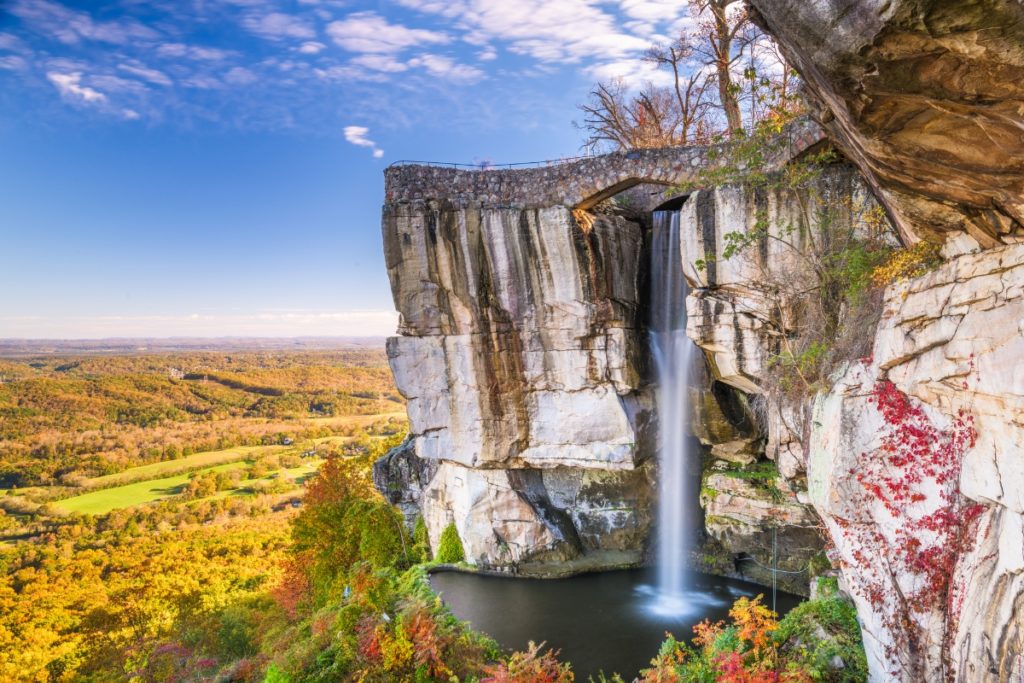
Tallulah Falls is another rockhounding spot of tremendous natural beauty. The Tallulah Falls formation is a large rock unit comprised of a 270-million-year-old dome that is comprised mostly of schist. This dome structure’s top is a quartzite schist with layers beneath it of graywacke-schist amphibolite, garnet aluminous schist, graywacke schist, and quartzite schist.
| Rocks / Minerals | Rarity |
|---|---|
| Citrine | Occasional |
| Quartz | Common |
| Smoky Quartz | Occasional |
Villa Rica Mine
This mine site has long been in use for the extraction of copper, since at least before the Civil War. The mining site comprises a number of shafts, some of which have collapsed. There is a variety of different parent rocks that determine which minerals can be found where.
| Rocks / Minerals | Rarity |
|---|---|
| Copper | Occasional |
| Garnet | Occasional |
| Pyrite | Common |
| Calcite | Occasional |
| Quartz | Common |
The Best Pay-to-Dig Sites for Rockhounding in Georgia

Graves Mountain Mine
Considered one of, if not the best, places to rockhound in the state, the Graves Mountain Mine is located in northeast Georgia. Many nice specimens of many minerals can be found at this site. The site is open by appointment only apart from two days per year (once in May and once in October) when the pubic is invited to dig and participate in a rock swap.
For access to the site for the rest of the year, the interested rockhounding group can get in touch with the caretaker, Junior, at 706-401-3173 for access to the site. The minimum group size is two individuals. Children twelve and under are not allowed on site. Given the heat of the summers in Georgia, the best time of year to collect is September through May.
More information on the Graves Mountain Mine can be found here.
| Rocks / Minerals | Rarity |
|---|---|
| Lazulite | Occasional |
| Rutile | Occasional |
| Pyrophyllite | Occasional |
| Kyanite | Occasional |
| Hematite | Occasional |
| Pyrite | Common |
| Ilmenite | Occasional |
| Muscovite | Common |
| Quartz | Common |
Hogg Mine
The Hogg Mine is another one of the most popular rockhounding sites in the state. This pay-to-dig site is located to the southwest of Atlanta, not all that far from the border with Alabama. Each participant may take home one five-gallon bucket of excavated material. The cost to dig per adult is $35, kids 16 and under are free with one paying adult, for the public digs held several times each month.
For private digs, the cost is $35 per adult plus a $100 guide fee. Each rockhound must bring their own equipment (hand tools only). It is recommended to bring a pick, shovel, potato rake, rock hammer, sledge hammer, chisels, buckets, and safety gear (gloves, eye protection, etc).
| Rocks / Minerals | Rarity |
|---|---|
| Amethyst | Occasional |
| Aquamarine | Occasional |
| Beryl | Occasional |
| Garnet | Common |
| Mica | Common |
| Quartz | Common |
| Tourmaline | Occasional |
Jackson Crossroads Amethyst Mine
The Jackson Crossroads Amethyst Mine is well-known for the high-quality crystals of amethyst that can be found here. The mine itself is an open-pit mine with fairly easy access, making it a good place to look for minerals for rockhounds of all ages; however, children are only permitted on site on a few particular dates.
Tools are not provided, so plan to bring your own. Some of the recommended tools to bring are five-gallon buckets, a rock hammer, a hand rake, a hand shovel, and personal safety gear such as gloves, eye protection, sunscreen, and the like.
| Rocks / Minerals | Rarity |
|---|---|
| Amethyst | Common |
BTW: Do you want to know more about rock and mineral identification? The books listed below are the best ones you can find on the internet (Amazon links):
- Smithsonian Handbooks: Rocks & Minerals
- Gemstone & Crystal Properties (Quick Study Home)
- Ultimate Explorer Field Guide: Rocks and Minerals (National Geographic Kids)
Other Notable Rockhounding Spots in Georgia
In addition to the sites mentioned above, there are many other good spots to rockhound in the state of Georgia, which you can learn more about in the following sections.
Spots in Northern Georgia
Here are some additional rockhounding sites in the North of Georgia.
| Site | Public / Pay | GPS Location | Common Rocks / Minerals |
|---|---|---|---|
| Rising Fawn Hill | Public | 34.747279, -85.540427 | Halloysite |
| Graysville quarries | Public | 34.941951, -85.117679 | Barite, calcite, fluorite, galena |
| Tarr Creek gravels | Public | 34.757099, -84.989666 | Jasper, siliceous oolite |
| Murray County streams | Public | 34.793196, -84.750293 | Quartz |
| Cole’s Crossing | Public | 34.945859, -84.264860 | Staurollite |
| Windy Ridge | Public | 34.925955, -84.289658 | Staurollite |
Spots in South Georgia
In addition to the sites listed above, here are some more sites that can be found in South Georgia.
| Site | Public / Pay | GPS Location | Common Rocks / Minerals |
|---|---|---|---|
| Withlacoochee River | Public | 30.641400, -83.320078 | Agatised coral |
| Flint River gravels | Public | 31.560143, -84.143612 | Jasper |
| Osierfield | Public | 31.649429, -120845 | Tektites |
| Cordele streams | Public | 31.976360, -83.797479 | Moss agate, jasper |
| Dodge County | Public | 32.307003, -83.243961 | Tektites |
Spots in East Georgia
| Site | Public / Pay | GPS Locations | Common Rocks / Minerals |
|---|---|---|---|
| Coldwater Creek mines | Public | 34.243609, -82.863250 | Aquamarine, garnet, tourmaline, beryl, quartz |
| Dewy Rose creeks | Public | 34.193798, -82.958154 | Amethyst, aquamarine, quartz |
| Bowserville schists | Public | 34.372508, -83.083367 | Sillimanite |
| Sparta | Public | 33.261067, -995711 | Carnelian, chalcedony, jasper |
| Lake Sinclair | Public | 33.257680, -83.226851 | Quartz |
| Maysville streams | Public | 34.247541, -83.565706 | Quartz |
Spots in West Georgia
| Site | Public / Pay | GPS Locations | Common Rocks / Minerals |
|---|---|---|---|
| Garnet Hill | Public | 33.883495, -84.798152 | Garnet |
| Arabia Mountian | Public | 33.686517, -84.109927 | Tourmaline |
| Stone Mountain | Public | 33.799904, -84.157142 | Quartz |
| Lithonia quarries | Public | 33.729688, -84.099633 | Calcite, epidote, fluorite, garnet, thulite, zeolite |
| Tallapoosa River | Public | 33.586162, -85.105757 | Ruby |
| Hurricane Creek | Public | 32.926370, -84.450024 | Beryl, kyanite, quartz |
| Heron Mine | 32.918057, -84.139999 | Apatite, beryl, mica, quartz |
TIP: The Peach State possesses a diverse collection of rocks and minerals, making it a great stop for rockhounding enthusiasts. Find out the complete guide in the article below:
14 Common Rocks & Minerals You Can Find in Georgia
Rockhounding Clubs in Georgia
Augusta Gem and Mineral Society
The Augusta Gem and Mineral Society’s focus is on the appreciation of and education about gems, minerals, the lapidary arts, and fossils. The society offers monthly meetings, events, an annual gem, mineral, and fossil show, a newsletter, and field trips. Membership in the society costs $15 for individuals, $20 for families, and $1 for juniors. Their website can be found here.
Athens Rock and Gem Club
The Athens Rock and Gem Club is a non-profit organisation located in Athens, Georgia. The stated purpose of the club is the promotion of the recreational and scientific aspects of the lapidary arts and rock and mineral collecting.
The club offers members meetings and has a newsletter for members of the club. To become a member, the following fees will need to be paid: $15 for a single adult, $17.50 for a family of two, and $20 for families of three or more. Their webpage can be found here.
The Georgia Mineral Society
The Georgia Mineral Society is the oldest and largest gem and mineral society in the Southeast and is a large and active educational organisation, founded in 1935. The society is particularly focused on the youth of Georgia and the other members of society, and seeks to promote public interest in the Earth Sciences.
The society offers regular meetings, field trips, a library, workshops, and special events. There is a group within the society that is for kids only, which also offers field trips and other educational opportunities. The dues for membership are $25 per year for either a single person or a family. The society’s website can be found here.
The Rome Georgia Mineral Society
This society is composed of amateur and professional fans of the Earth Sciences, including geology, lapidary arts, mineralogy, and palaeontology. Additionally, the society promotes good fellowship and proper ethics regarding these subjects.
The society provides its members with regular meetings, seminars, workshops, field trips to local rockhounding sites, and more. The webpage of the society can be found here.
The Cobb County Gem and Mineral Society
The Cobb County Gem and Mineral Society does not restrict members to residents of Cobb County, but welcomes any enthusiast from anywhere in the world to become a member. Based in Marietta, the society is a non-profit organisation that has been around for over fifty years.
The society focuses on bringing together people with expertise or interest in the lapidary arts, geology, mineralogy, and palaeontology, to expand skills and knowledge and share information with the general public. This society offers monthly meetings, classes, and has a dedicated clubhouse with workshops, a meeting room, and a kitchen. The society’s website can be found here.
State Gem, Mineral, and Fossil


The state mineral of Georgia is staurolite, designated as such in 1976. Also called fairy crosses, staurolite is commonly found across the north of the state. This usually opaque mineral is reddish brown to black and has a hardness of around 7. The mineral is usually found as twinned crystals in a characteristic cross shape and is most often found in Fannin County. These minerals are frequently kept as good luck charms.


The state gemstone of Georgia is quartz. In 1976, Georgia selected quartz to be the official state gem. The two primary varieties of quartz found in the state are clear quartz and amethyst.


The state fossil of Georgia is the shark tooth, which was designated as such in 1976. These fossils are common in the coastal plain of Georgia and can be found in a variety of colours, including black, white, grey, brown, and in tints of blue and red.
Recommended Rockhounding Gear
While special gear is not required to find nice rocks and fossils, having the right tools will help you find more than what’s simply laying around on the open ground. Here are some of the more basic tools and safety gear for interested rockhounds.
Geological Hammer
This 22oz Pointed-Tip Rock Pick by Estwing (Amazon link) is recommended for its durability and shock-reducing grip.
A rock pick is essential when collecting mineral specimens from a hard substrate such as stone. The pick’s handle is shock-resistant, making it more comfortable for use for longer times in the field.
Geology Pick
The Geology pick by Estwing (Amazon link) is a good choice for those starting out in the hobby as well as seasoned professionals.
The hammer comes with a pointed tip on one side of the head and a chiseled end on the other. This pick is good for excavating interesting mineral and fossil specimens.
Mini Shovel
The Mini D-Handle Round Point Shovel by Stanley (Amazon link) pairs convenience with durability. Especially in areas of soft material such as sand or clay, it is nice to have a sturdy shovel that is easy to carry.
The D-shaped handle gives you more leverage when digging on your knees, which is something that similarly sized standard-handled shovels wouldn’t provide.
Heavy Duty Work Gloves by Ironclad
Working with your hands in rockhounding environments can be rough; it is easy to get cuts or abrasions when in the field. Protecting your hands is important, especially while working with sharp or abrasive rocks.
The Heavy Duty Work Gloves by Ironclad (Amazon link) protect your hands from sharp rocks and tools. They are machine washable, highly abrasion resistant, and durable.
Safety Glasses
Eye protection is a must when breaking up a rock or any sort of work where debris could cause injury to your eyes.
The 3M Safety Glasses (Amazon link) are anti-fog and have a corded earplug system, as well as a removable foam gasket. The clear, scratch-resistant lenses shield the eyes against harmful ultraviolet light as well as prevent eye injury from flying rock chips.
First Aid Kit
With its 299 pieces, the Only Emergency First Aid Kit (Amazon link) is a good one for rockhounds. Of course, it’s best to avoid injuring yourself but if things go wrong it’s good to be prepared.
Some of the items found in the kit include fabric and plastic bandages, painkillers, gauze and pads, cold packs, wound closers, and many more.
Conclusion
Georgia is a state that has a lot to offer the rockhounder and is a fantastic place to explore, not just due to the nice variety of rocks and minerals that can be found but also due to the exceptional scenery that you can admire while on your rockhounding excursions. The state has a nice variety of geologic features and landscapes that provide many locations to seek out good specimens.
For visitors or for those new to the state, a good place to start your rockhounding adventures is by contacting the rockhounding societies listed earlier in the article. These societies have a wealth of knowledge and are happy to share their accumulated knowledge and experience with like-minded people.
TIP: If you want to know more about gold prospecting in Georgia, check out the complete guide in the article below:
Gold Prospecting in Georgia: 7 Best Locations & Laws