As an Amazon Associate, I earn from qualifying purchases with no additional costs for you.

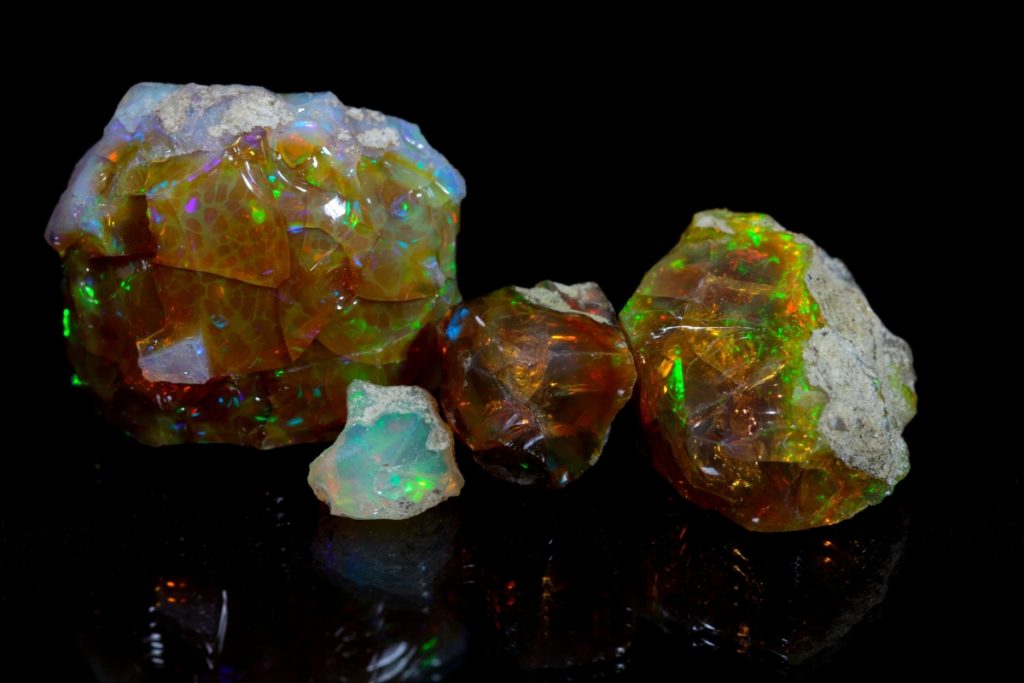
Opal is hydrated silica (SiO₂·nH₂O), a mineraloid with no crystal structure that can hold up to about 20% water. It rates 5.5–6 on the Mohs scale.
Common opal can cost just a few dollars, most precious opal sells for about $10–$150 per carat, and the finest Australian black opal can reach around $10,000 per carat.
Nevada’s Virgin Valley and Idaho’s Spencer Opal Mine are the top U.S. places to dig. Quick ID check: look at the stone from the side — layers or columns of color mean a doublet, triplet or synthetic.
What Is Opal?
Opal forms at low temperatures when silica-rich water seeps into cracks and cavities in rock, then slowly evaporates and leaves the silica behind, according to GIA. It is a mineraloid rather than a true mineral because it has no crystal structure.
Precious opal is built from tiny silica spheres stacked in a grid. Light diffracting between them creates play-of-color: spheres about 0.1 microns across produce violet, about 0.2 microns produce red, and sizes in between produce the rest of the rainbow. Common opal has spheres of irregular size, so it shows color but no flashes.
Australia dominates the market, producing about 95% of the world’s precious opal, and opal is its national gemstone, according to Geoscience Australia. Coober Pedy is famous for white opal, Lightning Ridge for black opal and Queensland for boulder opal.
Opal has been prized since antiquity — the Romans ranked it among the most precious stones, according to GIA — and today it is one of the two birthstones for October.
Opal at a Glance
These basic properties help when examining an opal or deciding how to care for it.
| Property | Opal |
|---|---|
| Chemical formula | SiO₂·nH₂O (hydrated silica) |
| Structure | Amorphous mineraloid, no crystals |
| Hardness (Mohs) | 5.5–6 |
| Water content | Up to about 20% |
| Optical effect | Play-of-color in precious opal |
| Main sources | Australia, Ethiopia, Mexico, Brazil, U.S. (Nevada, Idaho, Oregon) |
The Main Types of Opal
The trade sorts opal mainly by its background color and transparency.
- Black opal: a dark body color that makes play-of-color pop — the rarest and most valuable type.
- White opal: play-of-color on a white to light-gray background.
- Crystal opal: transparent to semitransparent with vivid play-of-color.
- Boulder opal: opal cut together with its ironstone host rock.
- Fire opal: transparent to translucent yellow, orange or red, with or without play-of-color — the classic Mexican opal.
- Common opal: no play-of-color, including blue and pink Peruvian opal.
Real vs. Fake Opal: How to Tell
High prices and huge demand have produced many opal imitations. The most common are assembled stones — doublets and triplets — followed by glass, plastic, synthetic opal and treated natural opal.

Know the Common Fakes
Each type of fake has its own tell-tale signs.
- Doublets: a thin slice of real opal glued to a dark backing such as black glass, onyx or plastic. GIA classes these as assembled stones.
- Triplets: the same, with a clear dome of quartz, glass or plastic on top to protect a very thin opal layer.
- Synthetic opal: lab-made opal, such as Gilson opal, with the same silica makeup but an overly regular pattern.
- Glass and plastic: “Slocum stone” and opalescent glass or resin, sometimes sold as “opalite.”
- Treated opal: porous opal darkened by smoke or a sugar-and-acid treatment to imitate black opal.
Six Checks for Real Opal
Look at the stone carefully from every angle before you buy.
- Side view: a natural solid opal looks the same all the way through. A visible glue line or dark layer means a doublet or triplet.
- Columns of color: vertical, column-like color when viewed from the side is typical of synthetic opal.
- Lizard-skin pattern: a regular, scaly “snakeskin” pattern on the face is another sign of synthetics.
- Soot spots: tiny black specks can reveal smoke or sugar treatment.
- Bubbles and swirls: glass imitations often show them, along with curved, shell-like chips.
- UV light: many natural opals fluoresce under UV, while many synthetics do not — useful as a supporting clue rather than proof.
BTW: If you are looking for the best UV light for rockhounding, find out my picks below (Amazon links):
- BEST OPTION: Convoy 8+ 365nm UV LED Flashlight with Patented Glass Filter
- BUDGET OPTION: Karrong Rechargeable 1200 Lumen 395nm UV Flashlight
- OPTION FOR INDOOR USAGE: Prime Upgraded Big Chip 396nm UV
The table below brings the main differences together. For an expensive stone, a gemological lab report is always worth it.
| Feature | Natural Opal | Fakes |
|---|---|---|
| Side view | Uniform, same as the front | Layers (doublets, triplets) or columns (synthetics) |
| Play-of-color | Random, irregular patches | Repetitive, overly neat patterns |
| Surface pattern | Natural, organic flashes | “Lizard skin” in synthetics |
| Dark specks | None in untreated opal | Soot spots from smoke or sugar treatment |
| Inclusions | Occasional natural matrix | Bubbles and swirls in glass |
| Hot needle | No reaction | Plastic melts and smells burnt |
How Much Is Opal Worth?
Opal prices cover an enormous range. Most precious opal sells for about $10–$150 per carat, fine stones for several hundred, and exceptional Australian black opal for up to around $10,000 per carat.

What Makes Opal Valuable
According to GIA, opal is judged on color, pattern and clarity, and traders add several other factors.
- Background color: black and dark bodies create the most contrast and bring the highest prices.
- Play-of-color: a full spectrum is rarest, and red flashes are the most prized.
- Pattern: broad harlequin patches beat small pinfire dots, and flame and peacock patterns have their own following.
- Brightness: the Australian trade grades brilliance on a scale from B1 (brightest) to B7 (dullest).
- Clarity and crazing: cloudiness, cracks and crazing — a web of fine cracks from water loss — cut value sharply.
- Shape and origin: a well-domed cabochon and a famous field add value, while any treatment or assembly lowers it.
The table below shows typical price ranges by opal type and color.
| Opal Type | Typical Price per Carat |
|---|---|
| Black opal | From $60; exceptional stones $6,000–$10,000 |
| White opal | $10 – $150 |
| Fire opal | $40 – $500 |
| Blue opal | $7 – $300 |
| Pink opal | $7 – $300 |
| Ethiopian opal | $5 – $250 |
Origin shapes prices too. Australian opal leads the market, Ethiopian Welo opal offers bright color at lower prices, Mexican fire opal is valued for its warm body color, and U.S. material such as Oregon and Louisiana opal is mostly bought as rough.
BTW: Do you want to know more about rock and mineral identification? The books listed below are the best ones you can find on the internet (Amazon links):
- Smithsonian Handbooks: Rocks & Minerals
- Gemstone & Crystal Properties (Quick Study Home)
- Ultimate Explorer Field Guide: Rocks and Minerals (National Geographic Kids)
Caring for Opal
Opal is softer than quartz and holds water in its structure, so it needs gentler handling than most gems. A little care prevents scratches and crazing.
- Avoid heat and sudden changes: hot water, steam, strong sun and jewelry torches can crack it.
- Clean gently: use a soft cloth with lukewarm water and mild soap — never ultrasonic or steam cleaners.
- Keep doublets and triplets dry: soaking can loosen the glue layers.
- Store it separately: harder gems such as quartz, sapphire and diamond will scratch it.
Where to Find Opal
Opal forms in cracks and cavities in sandstone, rhyolite, basalt and limonite, often where volcanic ash or silica-rich water was present. The best places to search are mines and their waste piles, desert washes and draws, canyons, and volcanic outcrops.
Nevada, Idaho and Oregon are the richest opal states in the U.S. The table below lists the best-known areas.
| State | Where to Look | What You Can Find |
|---|---|---|
| Nevada | Virgin Valley fee-dig mines (Royal Peacock and others), Fish Lake Valley | Black fire opal, opalized wood, common opal |
| Idaho | Spencer Opal Mines (fee dig), Lewiston area creeks, Moscow area basalts | Fire opal, precious opal, hyalite |
| Oregon | Opal Butte, White Rock, Priday agate beds (fee) | Hyalite and precious opal in nodules |
| Washington | Waterville, Mondovi and Pullman lava outcrops | Common and fire opal |
| Utah | Clifton district and Gold Hill mines, Moab area river bars | Common opal and opalized wood |
| Louisiana | Catahoula Sandstone outcrops near Leesville | Louisiana opal — sandstone with opal cement |
Nevada’s Virgin Valley black fire opal is the state’s official precious gemstone, and fee-dig mines such as Royal Peacock let the public dig for a daily fee. In Idaho, the Spencer Opal Mines offer half-day and full-day digs from mid-April to mid-October, according to BoiseDev.

Tips for Finding Opal in the Field
Opal hunting is slow work, but a few habits improve your odds.
- Look for opalized wood: in Virgin Valley much of the opal replaced buried branches and wood, so follow wood-rich clay layers.
- Wet the rock: a spray of water brings out play-of-color that is invisible on dry, dusty pieces.
- Check nodules and seams: in Oregon and Idaho, opal often fills cavities in rhyolite nodules and thin cracks in volcanic rock.
- Keep fresh finds damp: some opal, especially from Virgin Valley, crazes if it dries out too quickly, so many miners store it in water.
Use this guide as a starting point, not a final authority. Follow posted signage, and always get the landowner’s permission before collecting on private property.
Access rules and land ownership change over time, so confirming that collecting is currently allowed — and whether a permit is required — is your responsibility. Where coordinates are listed, treat them as a general reference only. How to Find Rocks is not responsible for the accuracy of the information here or for any outcome resulting from its use.
Opal fractures easily and can crack if it dries too fast, so bring a spray bottle and damp cloth or zip-top bags to keep finds moist. A rock hammer, chisel, gloves, eye protection and plenty of water complete the kit.
Recommendation box: All tools and equipment you need for rockhounding and rock identification* (Amazon links):
1. Estwing Rock Hammer – Light, comfortable, and extremely durable hammer.
2. Estwing Geologist Pick – Classic and the most trusted paleo pick in the world.
3. Finder 12-inch Chisels – Heavy-duty chisels set with hand protection.
4. Mini Handle Shovel – This is a great tool for digging deep in the dirt.
5 Ironclad Utility Work Gloves – Breathable, but they also protect the areas requiring them most.
6. 3M Safety Glasses – Comfortable and efficient goggles for rockhounding.
7. Convoy 8+ UV Light – 365nm UV LED flashlight with a patented glass filter.
8. Wesley’s Jewelers Loupe – High magnification options (30X and 60X) with carrying case.
9. Mohs Hardness Kit – A specially designed kit for rockhounds
*All recommended products are personally tested and regularly used by experts from this website.
FAQ About Opal
These are the questions people ask most often about opal.
What color opal is the most valuable?
Black opal, with a dark body color and bright play-of-color, is the most valuable. Red flashes on a black background command the highest prices.
Is opal worth more than diamond?
Usually not per carat, but the finest black opals can outprice many diamonds. Top Australian black opal can reach around $10,000 per carat.
Why does opal crack?
Opal contains water, and sudden heat or very dry conditions can make it lose moisture and develop crazing. Keep opal away from heat and harsh sunlight.
Are doublets and triplets fake?
They contain real opal, but only a thin slice glued to other materials. They are legitimate when clearly disclosed and priced accordingly, but they are not solid opal.
What is fire opal?
Fire opal is transparent to translucent opal with a yellow, orange or red body color. It may or may not show play-of-color, and Mexico is the classic source.
Can opal get wet?
Solid opal can be washed briefly with lukewarm water. Doublets and triplets should be kept dry, because water can seep into the glue layers.
Where does most opal come from?
Australia, which supplies about 95% of the world’s precious opal. Ethiopia has become a major source since the 2000s, and Mexico is known for fire opal.
Is it hard to find opal in the U.S.?
Precious opal is scarce in the wild, but fee-dig mines in Nevada and Idaho make finding it realistic for anyone. Common opal is much easier to find across the West.
How can you tell if an opal is a doublet?
Look at the edge from the side. A doublet shows a straight line where the opal slice meets a dark backing, and the back of the stone is usually flat, black and featureless.
Is Ethiopian opal real opal?
Yes. Ethiopian Welo opal is natural precious opal, often very bright. It tends to be porous and can temporarily turn clear when wet, so keep it away from oils and dyes.
| Research Behind This Guide |
|---|
This guide was compiled and edited by the How to Find Rocks team. It consolidates, fact-checks, and builds on original research and field reporting first published on this site by the following subject-matter expert(s): Olena Rybnikova — Ph.D. candidate in Mineralogy and GIA Applied Jewelry Professional, with published research on the peer-reviewed portal Scopus. See all articles by Olena → |