As an Amazon Associate, I earn from qualifying purchases with no additional costs for you.

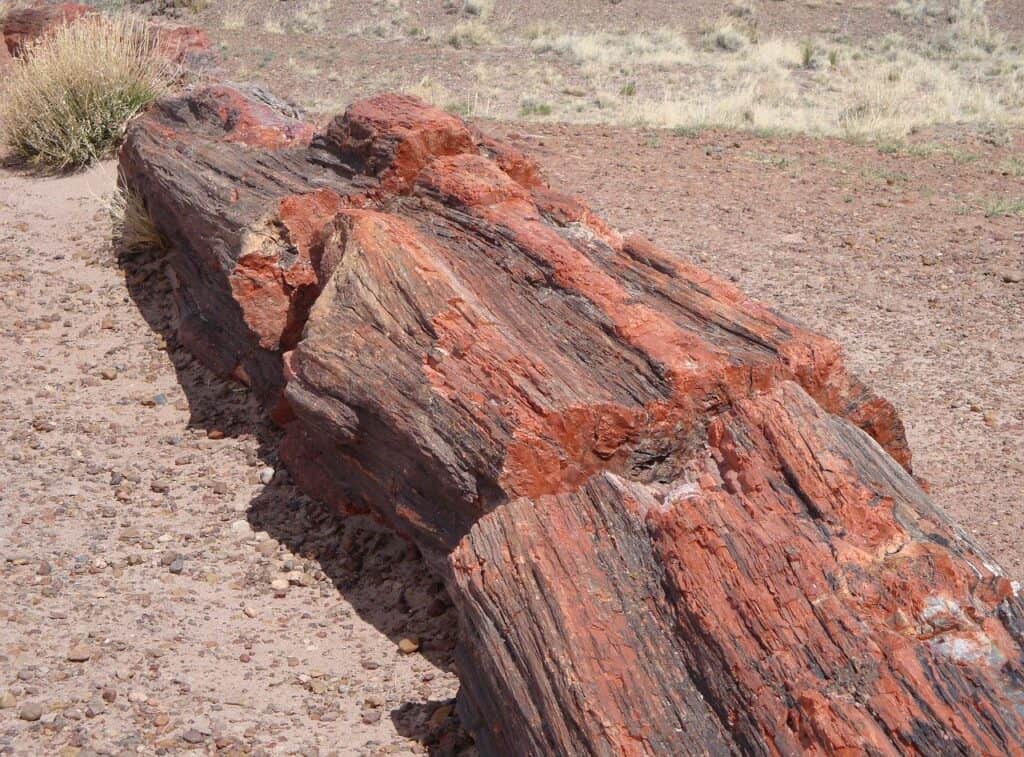
Petrified wood is a fossil in which the original wood has been replaced by minerals, mostly quartz, while keeping its rings and grain. Silica-rich pieces rate about 7 on the Mohs scale.
Rough petrified wood typically sells for about $0.25–$10 per pound, while polished slabs, opalized wood and large round sections can bring hundreds or thousands of dollars.
Arizona, Wyoming, Utah, Oregon and the Dakotas are the best U.S. states for it. Quick ID check: real petrified wood is heavy, cool to the touch and cannot be scratched with a knife.
What Is Petrified Wood?
Petrified wood forms when a tree is buried quickly by sediment or volcanic ash, cutting off oxygen and slowing decay. Mineral-rich groundwater then seeps through the wood, and minerals crystallize in its cells as the organic material breaks down.
In Petrified Forest National Park, silica dissolved from volcanic ash turned logs more than 200 million years old into almost solid quartz, according to the National Park Service. Traces of iron, carbon and manganese produce the rainbow of reds, yellows, purples and blacks.
Most petrified wood is silica — chalcedony, jasper or agate — but other minerals can do the job too. The Oklahoma Geological Survey notes that some “petrified wood” is really a cast, formed when sediment filled the mold left by a decayed log.
Here are the key properties of petrified wood, which differ slightly depending on the mineral that replaced the wood.
| Property | Petrified Wood |
|---|---|
| Type | Fossil preserved as a mineral replacement of wood |
| Main minerals | Quartz, chalcedony and opal; less often calcite or pyrite |
| Hardness (Mohs) | About 7 for silicified wood; 5.5–6.5 for opalized wood; about 3 for calcite wood |
| Specific gravity | About 2.6–2.9, noticeably heavier than a normal rock of the same size |
| Luster | Dull to waxy on rough surfaces; glassy when polished |
| Colors | Brown, red, yellow, black, white, and rarely green, blue or purple |
| Typical age | Tens to hundreds of millions of years |
| State symbol | State gem of Washington; state fossil of Arizona; petrified palmwood is the state stone of Texas and the state fossil of Louisiana |
What Petrified Wood Is Made Of
The replacing mineral controls the color, sparkle and value of each piece.
- Silica (quartz, chalcedony, agate, jasper): the most common, giving hard, glassy wood that takes a high polish.
- Opal: produces opalized wood, and rare pieces with precious opal show play-of-color, as Geology.com explains.
- Calcite: softer, tawny wood, sometimes with crystals lining hollow centers.
- Iron oxides: hematite and limonite give red, orange and yellow tones.
- Pyrite: adds a golden gleam, but pyritized wood can decay in damp air and must be kept dry.
Famous Types of Petrified Wood
Collectors often name petrified wood by the tree it came from or by the place it was found. A few types are worth knowing because they look different and sell for more.
- Palm wood: fossil palm shows small dots or rods across the grain, which are the preserved vascular bundles of the palm trunk. It comes mainly from Texas, Louisiana and the Gulf Coast states.
- Opalized wood: wood replaced by opal, famous from Virgin Valley in Nevada, where a few pieces carry precious opal with play-of-color.
- Limb casts: round branch sections from places like Eden Valley in Wyoming, often coated with a thin rind of fossil algae.
- Green wood: bright green petrified wood from central Oregon, such as the Hampton Butte area, is one of the most sought-after colors in the country.
- Agatized and jasperized wood: wood where the silica formed banded agate or opaque jasper, often with red and yellow colors from iron.
Color comes from trace elements carried in by groundwater. Iron oxides give red, yellow and brown, manganese gives black and pink, and copper or chromium are commonly credited for rare greens and blues.
Real vs. Fake Petrified Wood: How to Tell
Most rough petrified wood on the market is genuine, because it is abundant and inexpensive. Fakes turn up mainly in furniture, décor and costume jewelry, where real wood is stabilized with resin or molded resin is painted to look like stone.


Five Easy Tests
A few simple checks will separate real petrified wood from almost every imitation.
- Scratch test: silicified wood is about as hard as quartz, so a steel knife or glass will not scratch it. Fakes scratch easily.
- Weight test: real petrified wood is stone and feels heavy for its size, while resin and treated wood feel light.
- Grain test: look for continuous growth rings, rays and knots. Grain that is broken, blurry or repeated suggests a fake.
- Touch test: stone feels cool; resin and wood feel warm.
- Hot pin test: on a hidden spot, a red-hot needle does nothing to stone but melts resin and plastic.
Color is a clue too. Natural petrified wood shows gradual shifts of earthy browns, reds, yellows and grays, sometimes with purple or black from manganese — neon, perfectly uniform colors point to dye or resin.
The table below sums up the main differences.
| Feature | Real Petrified Wood | Fake Petrified Wood |
|---|---|---|
| Hardness | Not scratched by a knife or glass | Scratches easily |
| Weight | Heavy, like stone | Light, like wood or plastic |
| Grain | Continuous rings, rays and knots | Interrupted or artificial-looking |
| Luster when polished | Glassy | Resinous or waxy |
| Touch | Cool | Warm |
| Hot pin | No reaction | Surface melts |
| Bubbles | None | Can be present in resin |
Some furniture makers openly sell “stabilized” or resin-filled wood made to look petrified, which is fine when labeled. For slabs and décor, buy from dealers who can tell you where the material was collected.
How Much Is Petrified Wood Worth?
Petrified wood is one of the most affordable fossils to own. Rough material usually costs $0.25–$10 per pound, depending on quality and size, while polished pieces, opalized wood and large round slabs cut from whole logs can sell for hundreds or thousands of dollars.


What Makes Petrified Wood Valuable
Much of the value comes down to how striking and complete a piece is.
- Size: large pieces show off rings and patterns, and full round sections weighing hundreds of pounds are the most valuable.
- Color: vivid reds, yellows, blues and purples command more than plain gray or brown.
- Crystals and opal: quartz or amethyst crystals in cracks, and especially opalized wood, add sparkle and value.
- Preservation: clear cell structure, bark and knots make a specimen more desirable.
- Finish: a mirror polish, a good stand or a finished craft piece raises the price over raw rock.
- Condition: chips, cracks and scratches reduce value.
Where you buy matters as much as what you buy. Tourist shops near famous sites often sell low-grade bulk material, while rock and gem shows and specialist dealers offer better pieces at fair prices.
| Type | Typical Price |
|---|---|
| Rough, common material | $0.25 – $10 per pound |
| Polished small pieces and tumbled stones | A few dollars each |
| Polished slabs and bookends | $20 – several hundred dollars |
| Large polished round sections | Hundreds to thousands of dollars |
| Opalized wood with play-of-color | Priced individually; among the most valuable |
BTW: Do you want to know more about rock and mineral identification? The books listed below are the best ones you can find on the internet (Amazon links):
- Smithsonian Handbooks: Rocks & Minerals
- Gemstone & Crystal Properties (Quick Study Home)
- Ultimate Explorer Field Guide: Rocks and Minerals (National Geographic Kids)
Where to Find Petrified Wood
Petrified wood turns up where ancient forests were buried by mud or volcanic ash. The best places to search are gravel bars in creeks and rivers, washes and eroded slopes in badlands, and designated BLM collecting areas.
Before you pick anything up, know the rules. On BLM land you may take up to 25 pounds plus one piece per day, and no more than 250 pounds a year, under the BLM’s collecting rules — but national parks and monuments allow no collecting at all.
| State | Where to Look | Notes |
|---|---|---|
| Arizona | BLM land north of Alamo Lake and in the McCracken Mountains | Petrified Forest National Park is strictly look-only |
| Wyoming | Blue Forest and Eden Valley area (Sweetwater County), Oregon Buttes | Blue agate-replaced wood around 50 million years old |
| Utah | San Rafael Swell, Hanksville area, Thompson Springs | The Wolverine petrified forest is inside a national monument — viewing only |
| Oregon | Hampton Butte (green wood), Bear Creek Rockhounding Area | BLM-designated sites |
| North Dakota | Badlands outside the national park | Theodore Roosevelt NP is look-only |
| Texas | Bryan–College Station area, Jewett, Mount Pleasant, Live Oak County | Mostly private land |
| Colorado | Numerous counties, including Douglas, Elbert and Mesa | Florissant Fossil Beds is look-only |
Some of the most famous petrified wood in the country is protected. The giant redwood stumps at Florissant Fossil Beds are up to 12 feet wide and about 34 million years old, and the North Dakota badlands hold Sequoia-type stumps up to 12 feet across, according to the North Dakota Geological Survey.
In Oregon, Hampton Butte near Brothers is known for unusual green petrified wood, according to Oregon Discovery. Many other sites across the West are on public land but checkerboarded with private ranches, so check land status before collecting.


Use this guide as a starting point, not a final authority. Follow posted signage, and always get the landowner’s permission before collecting on private property.
Access rules and land ownership change over time, so confirming that collecting is currently allowed — and whether a permit is required — is your responsibility. Where coordinates are listed, treat them as a general reference only. How to Find Rocks is not responsible for the accuracy of the information here or for any outcome resulting from its use.
Petrified wood is heavy, so bring a sturdy bag or bucket, gloves, a rock hammer and a way to weigh your finds against the daily limit. A spray bottle helps too — wetting a piece instantly reveals its grain and color.
Recommendation box: All tools and equipment you need for rockhounding and rock identification* (Amazon links):
1. Estwing Rock Hammer – Light, comfortable, and extremely durable hammer.
2. Estwing Geologist Pick – Classic and the most trusted paleo pick in the world.
3. Finder 12-inch Chisels – Heavy-duty chisels set with hand protection.
4. Mini Handle Shovel – This is a great tool for digging deep in the dirt.
5 Ironclad Utility Work Gloves – Breathable, but they also protect the areas requiring them most.
6. 3M Safety Glasses – Comfortable and efficient goggles for rockhounding.
7. Convoy 8+ UV Light – 365nm UV LED flashlight with a patented glass filter.
8. Wesley’s Jewelers Loupe – High magnification options (30X and 60X) with carrying case.
9. Mohs Hardness Kit – A specially designed kit for rockhounds
*All recommended products are personally tested and regularly used by experts from this website.
Caring for Petrified Wood
Most silicified petrified wood is as tough as quartz and needs very little care. Clean it with warm water, a drop of mild soap and a soft brush, then let it dry fully.
- Skip harsh chemicals: acids and strong cleaners can etch calcite-replaced wood and dull a polished face.
- Keep pyrite-rich pieces dry: wood with pyrite can slowly break down in humid air, so store it with low humidity and away from bathrooms and basements.
- Protect opalized wood from heat: opal holds water and can crack, or “craze,” if it dries out fast, so keep it away from heaters and strong sun.
- Store polished slabs apart: wrap them in cloth so harder stones do not scratch the polish.
Large logs and bookends can sit outdoors in a garden without harm, since silica does not weather quickly. Wipe off dust or bird droppings with plain water so the colors stay bright.
FAQ About Petrified Wood
These are the questions people ask most often about petrified wood.
Can you take petrified wood from Petrified Forest National Park?
No. Removing petrified wood, rocks or fossils from the park is prohibited. Buy legally collected pieces from shops outside the park instead.
How much petrified wood can you collect on BLM land?
Up to 25 pounds plus one piece per day, with a maximum of 250 pounds per person per year. Larger amounts need a permit.
Is petrified wood a rock or a fossil?
Both. It is a plant fossil, and because its wood has been replaced by minerals, it is also a rock — usually a form of quartz.
How long does wood take to petrify?
It varies with conditions, but the famous petrified forests formed over very long periods — Arizona’s logs are more than 200 million years old. Mineralization needs quick burial, low oxygen and steady mineral-rich water.
Can you polish petrified wood at home?
Yes, silicified petrified wood takes an excellent polish because its hardness is close to 7. You can use a rock tumbler with silicon carbide grits for small pieces, or diamond pads and a lapidary wheel for slabs.
What is opalized wood?
Opalized wood is petrified wood where opal, not quartz, replaced the original wood. It is lighter and slightly softer than agatized wood, and rare pieces from Nevada and Australia show play-of-color.
Why is some petrified wood so colorful?
The colors come from trace minerals in the groundwater that petrified the log. Iron gives the common reds and yellows, while manganese adds black and pink tones.
| Research Behind This Guide |
|---|
This guide was compiled and edited by the How to Find Rocks team. It consolidates, fact-checks, and builds on original research and field reporting first published on this site by the following subject-matter expert(s): Olena Rybnikova — Ph.D. candidate in Mineralogy and GIA Applied Jewelry Professional, with published research on the peer-reviewed portal Scopus. See all articles by Olena → |