As an Amazon Associate, I earn from qualifying purchases with no additional costs for you.

This guide covers the best rockhounding sites in Arkansas, the eight rocks and minerals you are most likely to find, and the land rules that decide where you can collect.
The key legal fact: most of Arkansas is private land, so you need the owner’s permission almost everywhere. Crater of Diamonds State Park and the fee-dig crystal mines around Mount Ida and Jessieville are open to anyone who pays, and the Ouachita National Forest allows small, hand-collected amounts in certain areas with a permit, with Crystal Vista as its one free designated site.
Start at Crater of Diamonds for diamonds, amethyst and jasper, then head to the Ouachita Mountains for some of the finest quartz crystals in the world.
Rockhounding Regulations & Laws in Arkansas
Arkansas is unusual among the top rockhounding states because so little of it is public land. Most of the public ground is national forest, in the Ouachita Mountains and the Ozarks, so the rules depend first on who owns the land.
- Private land (most of the state): always get the landowner’s permission before you collect. Many of the best quartz deposits sit on private claims that operate as fee-dig mines, where the daily fee is your permission.
- Crater of Diamonds State Park: the one state park built around collecting, where any rock or mineral you find is yours to keep. Hand tools only: motorized and battery-operated search equipment and ladders are banned, digging must stay inside the plowed search field, and each paying visitor may take out up to five gallons of processed concentrate per day, according to the park’s search area rules.
- Ouachita National Forest: the forest says rockhounding is available only in certain areas and requires a permit, so contact the forest or the local ranger district before you collect, according to the forest’s rockhounding rules. Quartz crystal is the main mineral of interest, and you may remove small amounts by hand from surface exposures for personal use only, never for sale. Digging into crystal-bearing veins is not allowed, and lands under a mineral contract, claim, permit or lease need the holder’s permission.
- Ozark–St. Francis National Forest: the Forest Service rockhounding guide generally provides for collecting rocks and minerals for personal use through a free use permit, and you should take only small, reasonable amounts. In wilderness and other special or protected areas, collecting may or may not be allowed, so check with the ranger district.
- National park units: Hot Springs National Park and the Buffalo National River are look-only. Federal rules prohibit removing rocks, minerals and fossils from national park land (36 CFR 2.1).
- Corps lakes, other state parks and city parks: removing rocks or minerals from Army Corps of Engineers lake lands is prohibited without written permission (36 CFR 327.14). Outside the Crater, state parks and city parks set their own rules, so ask the park office before you take anything.
- Artifacts and fossils: arrowheads, spear points and other artifacts may not be disturbed or removed from federal land. On national forest land, vertebrate fossils such as dinosaur bones and teeth may be collected only by qualified researchers under a permit, while common invertebrate and plant fossils may be casually collected for personal use, according to the Forest Service fossil rules.
The Arkansas Geological Survey publishes background on the state’s gemstones, from Crater diamonds to Ouachita quartz.
Use this guide as a starting point, not a final authority. Follow posted signage, and always get the landowner’s permission before collecting on private property.
Access rules and land ownership change over time, so confirming that collecting is currently allowed — and whether a permit is required — is your responsibility. Where coordinates are listed, treat them as a general reference only. How to Find Rocks is not responsible for the accuracy of the information here or for any outcome resulting from its use.
Best Rockhounding Sites in Arkansas
Most of Arkansas’ best collecting is packed into the Ouachita Mountains in the west-central part of the state, with Crater of Diamonds just to the south. Because so much land is private, the fee-dig mines are the most reliable places to dig.

The map below plots every site from the tables in this guide. Tap a point to see what you can find there and to start navigation.
Four of the six sites are the state park and fee-dig mines, where paying the fee is your permission to collect.
| Site | Access | GPS Coordinates |
|---|---|---|
| Crater of Diamonds State Park (state park — fee, keep what you find) | Fee | 34.032477, -93.672352 |
| Wegner Quartz Crystal Mines (private mine — fee) | Fee | — |
| Ron Coleman Mining (private mine — fee) | Fee | 34.662175, -93.100393 |
| Sweet Surrender Crystal Mine (private mine — fee, approximate) | Fee | 34.662594, -93.523773 |
| Crystal Vista (Ouachita National Forest — free, approximate) | Public | 34.504066, -93.612352 |
| Ouachita Mountains near Mena (general area — national forest, permit required) | Public | 34.59, -94.22 |
Crater of Diamonds State Park
Crater of Diamonds near Murfreesboro is the only place in the world where the public can search for diamonds in their original volcanic source and keep what they find. The search area is a 37-acre plowed field on the eroded surface of an ancient volcanic crater, and more than 37,000 diamonds have been found by visitors since it became a state park in 1972.
Diamonds are only part of the haul. The field also gives up amethyst, jasper, agate, garnet, quartz, hematite, peridot, diopside, epidote and pyrite.
The search area is open daily from 8 a.m. to 4 p.m., except on major holidays, and the park rents shovels, screens, buckets and full searching kits. Go after rain, when the soil washes away and heavier diamonds sit on the surface, and look for a small, rounded crystal with an oily shine that dirt does not stick to.
Wegner Quartz Crystal Mines
The Wegner Quartz Crystal Mines south of Mount Ida are the best-known crystal mines in the Ouachitas. According to Arkansas Tourism, you can search a 40-acre open field, dig a tailings area stocked with quartz crystals, or try a gemstone sluice.
Wegner is also one of the few places to find phantom quartz, crystals with ghostly inner outlines, and its Phantom Crystal Mine is open to groups. You pay a fee to dig, so call ahead for prices and opening days.
Ron Coleman Mining
Ron Coleman Mining in Jessieville, north of Hot Springs, is the other big name in Arkansas crystal digging. The Coleman family has worked the mine since the 1930s, and the 8,000-pound Berns Quartz, found at the Coleman Mine in 2016, now stands in the Smithsonian.
Visitors pay a digging fee and keep the quartz they find in the designated digging area, according to Arkansas Tourism. The site is at 211 Crystal Ridge Lane, and digging is best after rain, when the clay washes off the crystals.
Sweet Surrender Crystal Mine
Sweet Surrender is an open-cast, dig-your-own quartz mine near Washita and Story, north of Mount Ida. You hunt quartz veins for clear and iron-stained crystals and keep what you find for a fee.
The host rock here is shale, so some crystals carry other minerals on their faces. The GPS point is approximate, so follow the signs from Highway 27 north of Washita.
Crystal Vista
Crystal Vista near Mount Ida is the Ouachita National Forest’s one designated quartz crystal collecting site, and there is no fee to collect. It is a former mine, not an active one, so you collect crystals from the surface.
Commercial mines usually have better access to freshly uncovered crystal, but Crystal Vista is the place to go if you want to collect for free on public land. Contact the Womble Ranger District at (870) 867-2101 before you go.
Ouachita Mountains near Mena
The western Ouachita Mountains around Mena and Polk County are rich in quartz, chert and red novaculite. The national forest covers much of the high ground, so the forest rules above apply, including the permit.
Other Notable Spots in Arkansas
Beyond the best sites, Arkansas has many smaller collecting areas, but few of them are on clearly public land. The places below are grouped by who controls access.
Public Lands
Much of the Ouachita National Forest around Mount Ida, Story, Washita and Jessieville sits on the same quartz belt as the fee mines. Ask the Womble Ranger District in Mount Ida or the Jessieville-Winona-Fourche Ranger District which areas are open to rockhounding.
Private & Fee Sites
Several other crystal mines operate around Mount Ida and Jessieville. Coleman Rock Shop & Crystal Mines on Highway 7 north of Hot Springs has long offered fee digging in mine tailings, and the Avatar Crystal Mine near Mount Ida offers tailings digs, but check their current status before you go.
Common Rocks & Minerals You Can Find in Arkansas
GPS coordinates are a general reference only — always confirm access rules and land status before you go.
Arkansas’ geology splits between the flat-lying sedimentary rocks of the Ozark Plateau in the north and the folded, crystal-rich Ouachita Mountains in the west. A handful of igneous intrusions, like Magnet Cove and the Crater of Diamonds pipe, add rarer minerals to the mix.

The headline finds are quartz crystals from the Ouachitas and diamonds, amethyst, agate and jasper from the Crater, while shale, limestone, chert and novaculite are everywhere.
BTW: Do you want to know more about rock and mineral identification? The books listed below are the best ones you can find on the internet (Amazon links):
- Smithsonian Handbooks: Rocks & Minerals
- Gemstone & Crystal Properties (Quick Study Home)
- Ultimate Explorer Field Guide: Rocks and Minerals (National Geographic Kids)
If you want to check out the best book about rockhounding in Arkansas, you can find it by clicking here (Amazon link).
Rocks & Minerals
Each entry below shows how to recognize the stone and where to look for it in Arkansas.


Shale
How to recognize it: Soft, fine-grained gray, brown or black rock that splits into thin, flat layers and feels smooth, with an earthy smell when wet.
The best-known Arkansas shale is the Fayetteville Shale, a hard, dense black shale of Mississippian age that became famous for the natural gas it holds, with a big impact on the state’s economy. Shale is common wherever creeks cut through the hills of the Ozarks.
On the Ozark National Forest, look in creek banks and cuts along forest roads where fresh layers are exposed.

Limestone
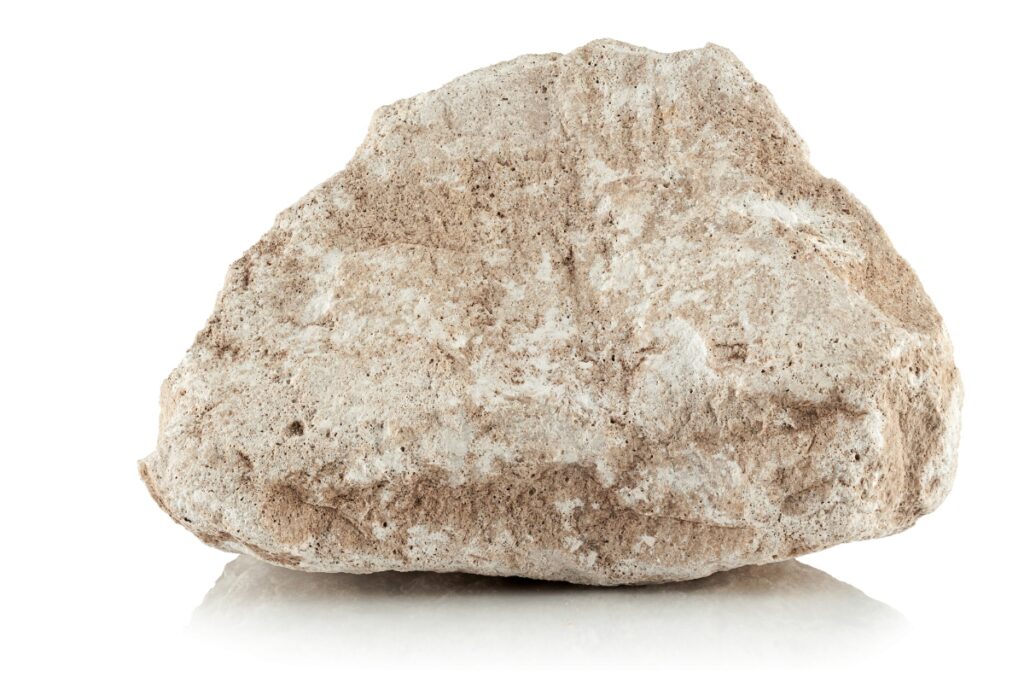
How to recognize it: Usually gray, cream or tan and fine-grained, often holding fossils; a drop of vinegar or dilute acid makes it fizz.
Arkansas limestone formed in shallow seas more than 320 million years ago, so it often holds fossils of sea creatures, and its finer grades are chosen for sculptures and ornamental stone. The Pitkin Limestone, called the Archimedes Limestone in the late 1890s, is known for screw-shaped fossils of the bryozoan Archimedes.
Limestone ledges and fossil-rich beds are widespread across the Ozark Plateau, and the Ozark National Forest is the main public land there where you may take a small amount.


Chert
How to recognize it: Dull to waxy, fine-grained stone in gray, tan, brown or black that breaks with smooth, curved, sharp edges; often found as nodules or layers in limestone.
Chert is as common as dirt in Arkansas. Its best-known variety is novaculite, a very fine-grained chert of the Ouachita Mountains of Arkansas and Oklahoma that Native Americans traded widely for tools and that is still quarried for the famous “Arkansas” and “Washita” whetstones.
Novaculite ranges from white to grayish-black, with lighter colors the most common, and impurities tint it red, pink or tan. Banded chert is common too. Look for chert on the Ouachita National Forest under the rules above, and see our guide on where to find chert for the best environments.


Agate
How to recognize it: Translucent when held up to light, with a waxy shine and banded, lace or moss-like patterns inside.
Arkansas agates are less colorful than western ones, but they show swirls of earthy colors and intricate patterns.
Agate turns up at Crater of Diamonds State Park.
| Location | GPS Coordinates |
|---|---|
| Crater of Diamonds State Park | 34.032477, -93.672352 |
Our agate guide explains how to tell it from jasper.


Jasper
How to recognize it: Opaque even at thin edges, with a smooth waxy feel and solid red, yellow, brown or green colors, often with swirls or spots.
Arkansas jasper is usually reddish-brown but also comes in black, brown and green, and it takes a high polish after tumbling. Much of the jasper near the Ouachita Mountains grades from red novaculite.
Crater of Diamonds produces jasper along with its diamonds.
| Location | GPS Coordinates |
|---|---|
| Crater of Diamonds State Park | 34.032477, -93.672352 |
In the Ouachita Mountains, look for red jasper where novaculite is exposed on the national forest, and our jasper guide covers identification step by step.


Quartz
How to recognize it: Glassy and hard enough to scratch glass, usually clear to white, often in six-sided crystals with pointed tips, breaking with curved, shell-like surfaces.
Quartz is the state mineral of Arkansas, and a quartz belt 30 to 40 miles wide runs through the core of the Ouachita Mountains, according to the Encyclopedia of Arkansas. Arkansas is one of a small number of places in the world with enough crystal to mine commercially, and its finest crystals are often compared with those from Brazil and Madagascar.
Crystal Vista is free, while Ron Coleman Mining and Sweet Surrender charge a digging fee.
| Location | GPS Coordinates |
|---|---|
| Crystal Vista | 34.504066, -93.612352 |
| Ron Coleman Mining | 34.662175, -93.100393 |
| Sweet Surrender Crystal Mine | 34.662594, -93.523773 |
The main quartz counties are Garland, Perry, Montgomery and Saline. Mount Ida, Story, Washita, Jessieville and Mena are the classic towns, and smoky quartz turns up near Jessieville.
Arkansas quartz comes as rock crystal, smoky quartz, amethyst and milky quartz, plus chalcedony, agate and jasper. Cut crystals are sometimes sold as “Hot Springs diamonds,” and our guide on real vs. fake quartz shows how to spot imitations.


Diamond
How to recognize it: Small, rounded crystals with a greasy, oily shine that dirt does not stick to, extremely hard and noticeably heavy for their size.
Diamonds have been found in Arkansas since 1906, diamond is the state gem, and Crater of Diamonds State Park is the only place in the state where you can search for one. The 40.23-carat Uncle Sam, found in 1924 before the site became a park, is still the largest diamond ever unearthed in the United States.
| Location | GPS Coordinates |
|---|---|
| Crater of Diamonds State Park | 34.032477, -93.672352 |
Famous finds at the site include the 16.37-carat Amarillo Starlight, the 8.52-carat Esperanza and the Strawn-Wagner Diamond, a 3.03-carat rough stone cut into a 1.09-carat gem with a perfect grade. The 15.33-carat Star of Arkansas was found in 1956, before the site became a state park.
Crater diamonds come in white, yellow and brown, and most are small, rounded crystals.


Amethyst
How to recognize it: Purple quartz, from pale lilac to deep violet, in glassy six-sided crystals or crystal-lined pockets, hard enough to scratch glass.
Arkansas amethyst runs in veins, so one find often means more nearby, and it ranges from clear to dark purple. Crystals are common at Crater of Diamonds.
Amethyst at the Crater turns up in the same plowed field as the diamonds.
| Location | GPS Coordinates |
|---|---|
| Crater of Diamonds State Park | 34.032477, -93.672352 |
For other states with good amethyst, see our guide on where to find amethyst.
Other Notable Rocks & Minerals in Arkansas
Arkansas has many more rocks and minerals than the common finds above.


Gold: most of what panners find is fine “flour” gold in the streams draining the Ouachita Mountains, and the Ouachita National Forest allows panning in some of its streams. Pyrite is common, so learn the difference with our pyrite vs. gold guide.
Fossils: the Ozark Plateau is the state’s fossil country, and crinoids, brachiopods, bryozoans, corals, blastoids, trilobites and mollusks turn up there, according to the Encyclopedia of Arkansas. On the Ozark National Forest, common invertebrate fossils like these may be collected under the fossil rules above.
Arkansas State Rock, Mineral & Gem
Arkansas named its three geological symbols together in 1967, according to the Encyclopedia of Arkansas. The state dinosaur followed in 2017.
| Symbol | Official Choice | Adopted |
|---|---|---|
| State mineral | Quartz crystal | 1967 |
| State gem | Diamond | 1967 |
| State rock | Bauxite | 1967 |
| State dinosaur | Arkansaurus fridayi | 2017 |
Arkansaurus fridayi is named after Joe B. Friday, who found the bones of its right hind foot in a shallow pit on his land near Lockesburg in Sevier County in 1972. It was a small, lightly built two-legged theropod of the Early Cretaceous, according to the Encyclopedia of Arkansas, and its bones are for museum viewing only.
Recommended Rockhounding Gear
While special gear is not required to find nice rocks and fossils, having the right tools will help you find more than what’s simply laying around on the open ground. Here are some of the more basic tools and safety gear for interested rockhounds.
Geological Hammer
This 22oz Pointed-Tip Rock Pick by Estwing (Amazon link) is recommended for its durability and shock-reducing grip.
A rock pick is essential when collecting mineral specimens from a hard substrate such as stone. The pick’s handle is shock-resistant, making it more comfortable for use for longer times in the field.
Geology Pick
The Geology pick by Estwing (Amazon link) is a good choice for those starting out in the hobby as well as seasoned professionals.
The hammer comes with a pointed tip on one side of the head and a chiseled end on the other. This pick is good for excavating interesting mineral and fossil specimens.
Mini Shovel
The Mini D-Handle Round Point Shovel by Stanley (Amazon link) pairs convenience with durability. Especially in areas of soft material such as sand or clay, it is nice to have a sturdy shovel that is easy to carry.
The D-shaped handle gives you more leverage when digging on your knees, which is something that similarly sized standard-handled shovels wouldn’t provide.
Heavy Duty Work Gloves by Ironclad
Working with your hands in rockhounding environments can be rough; it is easy to get cuts or abrasions when in the field. Protecting your hands is important, especially while working with sharp or abrasive rocks.
The Heavy Duty Work Gloves by Ironclad (Amazon link) protect your hands from sharp rocks and tools. They are machine washable, highly abrasion resistant, and durable.
Safety Glasses
Eye protection is a must when breaking up a rock or any sort of work where debris could cause injury to your eyes.
The 3M Safety Glasses (Amazon link) are anti-fog and have a corded earplug system, as well as a removable foam gasket. The clear, scratch-resistant lenses shield the eyes against harmful ultraviolet light as well as prevent eye injury from flying rock chips.
First Aid Kit
With its 299 pieces, the Only Emergency First Aid Kit (Amazon link) is a good one for rockhounds. Of course, it’s best to avoid injuring yourself but if things go wrong it’s good to be prepared.
Some of the items found in the kit include fabric and plastic bandages, painkillers, gauze and pads, cold packs, wound closers, and many more.
FAQ About Rockhounding in Arkansas
These are the questions that come up most often about collecting in Arkansas.
Can you really keep the diamonds you find in Arkansas?
Yes. At Crater of Diamonds State Park any rock or mineral you find is yours to keep, whatever its value, and you only pay the daily admission.
What is the largest diamond found in Arkansas?
The Uncle Sam, found in 1924 by Wesley Oley Basham, a worker of the Arkansas Diamond Corporation, weighed 40.23 carats. It was named after his nickname, was cut into a 12.42-carat emerald-cut gem, and is still the largest diamond ever found in the United States.
What is the largest diamond found since Crater of Diamonds became a park?
The 16.37-carat Amarillo Starlight, found in 1975. In 2020 Kevin Kinard found a 9.07-carat diamond, the second-largest since the park opened in 1972.
What is the best crystal mine in Arkansas?
The Wegner Quartz Crystal Mines near Mount Ida are the best-known, and one of the few places to find phantom quartz. Ron Coleman Mining in Jessieville is the other big name, where you dig your own crystals and keep what you find.
Where can you collect quartz for free in Arkansas?
Crystal Vista near Mount Ida is the Ouachita National Forest’s one designated quartz collecting site, with no fee. Elsewhere on the forest, rockhounding is offered only in certain areas and needs a permit, and you may take only small amounts by hand from surface exposures, never by digging into veins, and not on mining claims without the holder’s permission.
Can you pan for gold in Arkansas?
Yes, in some streams on the Ouachita National Forest, and most finds are tiny flakes of flour gold. Our guide to gold prospecting in Arkansas covers the best streams and rules.
What rare rocks can you find in Arkansas?
Novaculite from the Ouachita Mountains is found almost nowhere else, and you can look for it on the Ouachita National Forest. Crowley’s Ridge agate is the best-known local agate, but most of the ridge is private land, so collect there only with the owner’s permission.
What rare minerals can you find in Arkansas?
Diamond tops the list, and Crater of Diamonds is the only place in the state where you can search for one. Magnet Cove is famous for rare titanium minerals such as brookite, but it is almost all private land, so you need the owner’s permission. Arkansas quartz is also among the finest in the world.
What is the most famous rock or mineral found in Arkansas?
Quartz, the state mineral, with Arkansas diamonds a close second. Arkansas is one of the few places in the world where quartz crystals are mined commercially.
Conclusion
Arkansas packs two world-class experiences into a small area: searching for diamonds you can keep, and pulling quartz crystals out of the red clay around Mount Ida and Jessieville. Add agate, jasper and novaculite, and few states offer more variety per mile.
Start at the Crater and the fee-dig mines, then try Crystal Vista for free quartz. Pack all the tools you need for rockhounding, including a good rock hammer. If you are interested in checking out the best rockhounding tools, you can find them by clicking here (Amazon link).
| Research Behind This Guide |
|---|
This guide was compiled and edited by the How to Find Rocks team. It consolidates, fact-checks, and builds on original research and field reporting first published on this site by the following subject-matter expert(s): Van Pigtain — Former earth science and geology lab instructor at the University of North Texas and Cambridge-educated researcher with a Ph.D.-level background in Archaeology, backed by decades of hands-on fieldwork. See all articles by Van → Lauren Ballejos — Rockhounding enthusiast, member of the Flagg Mineral Foundation (FMF), and professional content writer with a growing personal rock collection. See all articles by Lauren → |