As an Amazon Associate, I earn from qualifying purchases with no additional costs for you.
Known for its diverse geology, Massachusetts is a small state with a lot of places to hunt for rocks, fossils, gemstones, and mineral specimens. The complex geological history of the state means the rockhounder can find sites with a wide variety of rocks and minerals not that far from each other. Several mountain-building events in the Palaeozoic Era (approximately 538 million years ago) formed the Appalachian Mountains, which make up the western portion of the state.
In addition to nice rockhounding, the state of Massachusetts has wonderful scenery, such as rocky beaches, rolling hills, forests, and more. Rockhounding in pleasant environments makes an enjoyable activity even more enjoyable. Rockhounding in Massachusetts is best done during the warmer seasons, as the winter weather can be brutal.
The Best Rockhounding Spots in Massachusetts Are:
| Site | Public or Private | GPS Coordinates |
|---|---|---|
| Betts Rhodonite Mine | Private | 42.494331, -72.946450 |
| Graves Mountain | Private | |
| Rice Quarry | Private | |
| Wright Emery Mine | Public | 42.27131, -72.96895 |
| Goshen | Public | 42.450082, -72.824966 |
| Reynolds Mine | Private | 42.69122, 72.14392 |
| Massachusetts Beaches | Public | |
| Berkshire County | Public | |
| Hampshire County | Public |
In Massachusetts, you can find and collect a wide variety of nice rock and mineral specimens, including malachite, agate, opal, thulite, cinnabar, jasper, amethyst, variscite, garnet, beryl, rhodonite, chalcopyrite, smoky quartz, and chalcedony, among others.

If you want to check out the best rockhounding equipment and tools, you can find them here (Amazon link).
Rockhounding Regulations and Laws in Massachusetts
Rockhounding on federal tracts of land (those managed by the Bureau of Land Management) is allowed. Some state parks permit the collection of rocks, minerals, and fossils from their lands.
As the rules regarding rockhounding on public and private lands are always changing, be sure to check with the state parks or landowners before you head out to new sites on your rockhounding adventures.
The Best Public Rockhounding Sites in Massachusetts
You can find the best rockhounding sites in Massachusetts that are open to the public below.
Wright Emery Mine
The Wright Emery Mine operated at least six mines in the 19th and 20th centuries. The primary focus of these mines was on emery extraction. These old mining sites are now open to rockhounders to collect nice mineral specimens.
The Wright Emery Mine follows a vein of minerals that is about 30 feet deep and 300 feet long, continuing across to Gobble Mountain. The tailings from the mine excavation are good places to look for mineral specimens. There are also ruins to explore on the site. This mine was the first in the country to find emery.
| Rocks / Minerals | Rarity |
|---|---|
| Margarite | Occasional |
| Magnetite | Common |
| Diaspore | Occasional |
| Pyrite | Common |
| Epidote | Occasional |
Goshen
There are several granitic pegmatite veins all around the town of Goshen. These are well-known for the high-quality specimens of beryl that can be found there, in particular a clear variety called Goshenite, which can be found at this site.
The pegmatite just north of Lily Pond is a good place to start your search. The Barrus Farm is also a good place to hunt for minerals and rocks. This collecting area has only opened recently.
| Rocks / Minerals | Rarity |
|---|---|
| Beryl | Occasional |
| Tourmaline | Occasional |
| Spodumene | Occasional |
| Clevelandite | Occasional |
| Mica | Common |
Massachusetts Beaches
The coastline around Boston and anywhere in coastal Massachusetts are nice place to rockhound, not to mention the beauty of the natural area and the rare ability to rockhound while barefoot, strolling along the shoreline. The areas where gravel accumulates are good places to search.
The beaches around Cohasset, Marshfield, and Sandwich are good places to find jasper. If you’re looking for more diverse types of rocks and minerals, the shoreline near Gay Head can produce amber and alum. The deposits of green sand are the best places to look for specimens.
| Rocks / Minerals | Rarity |
|---|---|
| Jasper | Common |
| Agate | Occasional |
| Alum | Occasional |
| Amber | Occasional |
| Epidote | Occasional |
Berkshire County
Located in the relatively mineral-poor eastern region of the state, the hills of Berkshire County are potentially the best places in the state to hunt for crystals of quartz, in particular the area around Monument Mountain, where you can find smoky quartz crystals.
The area just to the southeast of Pittsfield is one of the rare places where green quartz can be found. There are mines and quarries in this county, which are good places to look for talc and asbestos.
| Rocks / Minerals | Rarity |
|---|---|
| Asbestos | Occasional |
| Talc | Occasional |
| Green quartz | Rare |
| Smoky quartz | Occasional |
| Quartz | Common |
Hampshire County
This is one of the best places in the state of Massachusetts to find gemstones. A diverse array of precious and semiprecious gemstones can be found here, including agate, beryl, amethyst, prehnite, garnet, and rhodonite.
| Rocks / Minerals | Rarity |
|---|---|
| Agate | Common |
| Amethyst | Occasional |
| Beryl | Occasional |
| Rhodonite | Occasional |
| Garnet | Common |
| Magnetite | Common |
| Pyrite | Common |
| Chalcopyrite | Common |
| Emerald | Rare |
| Tourmaline | Rare |
BTW: Do you want to know more about rock and mineral identification? The books listed below are the best ones you can find on the internet (Amazon links):
- Smithsonian Handbooks: Rocks & Minerals
- Gemstone & Crystal Properties (Quick Study Home)
- Ultimate Explorer Field Guide: Rocks and Minerals (National Geographic Kids)
Best Pay to Dig Sites for Rockhounding in Massachusetts
Betts Rhodonite Mine
The Betts Rhodonite Mine, also known as the Betts Manganese Mine, is an old mine currently under the guardianship of Earthdance. Collecting is permitted for a $20 per person fee for those aged ten and over. Fees for children under 10 are $10.
Visits to the site must be arranged by email at least 48 hours in advance. The mine is closed between December and when the snow melts in spring, usually sometime in March or April.
The collecting site, the old mine dumps, is also where you’ll park your car, making the distance that needs to be hiked practically nil. Earthdance recommends bringing the following tools: a small rake, a mason’s hammer, a small sledgehammer, protective goggles, appropriate footwear, and gloves.
| Rocks / Minerals | Rarity |
|---|---|
| Garnet | Occasional |
| Magnetite | Common |
| Pyrite | Common |
| Rhodonite | Occasional |
| Kutnohorite | Occasional |
| Tephroite | Occasional |
| Chalcopyrite | Occasional |
Graves Mountain
Located in Littleton, Graves Mountain is a great place to rockhound, especially for those keen to find garnets. This is a popular site with hours that change by season and is open from dawn to dusk. There is an entry fee to collect at this site.
| Rocks / Minerals | Rarity |
|---|---|
| Garnet | Occasional |
Rice’s Quarry
Located in Bolton, this former feldspar-mica pegmatite was quarried starting around the year 1897. Twenty-two of these pegmatite bodies have been mineralised. The main area of production was from pegmatite number six. The most common minerals found at this site are quartz, feldspar, and mica.
This quarry offers a rather large array of minerals that can be found there. The quarry is open on weekends from 9 to 5 from April through October. There is a fee charged, and children get a discount.
| Rocks / Minerals | Rarity |
|---|---|
| Feldspar | Common |
| Mica | Common |
| Quartz | Common |
| Vivianite | Occasional |
| Zircon | Occasional |
Reynolds Mine (Beryl Hill Mine)
This is a family-owned operation located near North Royalston that charges a modest fee to rockhound on their land. The mine is situated in a granite pegmatite on Beryl Hill and is one of the best places to hunt for beryl. The beryl found at this site is typically found in what are termed ‘bunches’, meaning they are usually found in groups of crystals. Many of these specimens are gem-quality.
| Rocks / Minerals | Rarity |
|---|---|
| Beryl | Occasional |
| Smoky Quartz | Occasional |
| Mica | Common |
| Aquamarine | Rare |
Other Notable Rockhounding Spots in Massachusetts
In addition to the sites listed above, here are some more places that are good locations to look for rocks and minerals.
Spots in Eastern Massachusetts
Here are some additional rockhounding sites that can be found in eastern Massachusetts.
| Site | Public / Pay | GPS Location | Common Rocks / Minerals |
|---|---|---|---|
| Middlesborough | Public | 41.850298, -70.890418 | Agate, chalcedony |
| Marshfield beaches | Public | 42.114111, -70.669451 | Jasper |
| Cohasset beaches | Public | 42.261512, -70.810203 | Jasper, epidote |
| Malden slates | Public | 42.442916, -71.077145 | Novaculite, slate |
| Rockport quarries | Public | 42.690110, -70.633326 | Amazonite |
| Newbury mines | Public | 42.785112, -70.906430 | Chalcopyrite, pyrite, galena, sphalerite, siderite |
| Westfield | Public | 42.598181, -71.46760 | Chiastolite |
| Bolton Lime Quarry | Private | 42.439257, -71.567007 | Scapolite, apatite, mica, magnesite, opal, quartz |
| Sterling | Public | 42.436636, -71.761649 | Chalcopyrite, siderite |
Spots in Western Massachusetts
You can find some additional places in southern Massachusetts to rockhound here.
| Site | Public / Pay | GPS Location | Common Rocks / Minerals |
|---|---|---|---|
| Monument Mountain | Public | 42.258840, -73.349342 | Smoky quartz |
| Pittsfield | Public | 42.418278, -73.223237 | Green quartz |
| Blandford quarries | Public | 42.166221, -72.946265 | Beryl, feldspar |
| Plainfield | Public | 42.534349, -72.924828 | Ankerite, quartz, garnet, rhodochrosite, rhodonite |
| Zoar quarries | Public | 42.644178, -72.927248 | Talc |
| Davis Mine | Public | 42.683431, -72.864959 | Chalcopyrite, pyrite |
| West Chesterfield roadcut | Public | 42.403153, -72.880670 | Smoky quartz |
| Lane Quarry | Public | 42.116536, -72.689257 | Amethyst, datolite, prehnite |
| Deerfield River | Public | 42.526228, -72.645207 | Jasper, agate, chalcedony |
| Montague mines | Public | 42.507178, -72.524738 | Chalcopyrite, hematite |
| Lane Trap Rock Quarry | Public | 42.301243, -72.527078 | Amethyst, datolite, prehnite |
TIP: There are several methods for cleaning rocks from the beach. Below, you will find 7 simple and frequently used methods, so let’s look at them!
Cleaning Rocks From the Beach: 7 Ways How to Do It Properly
Rockhounding Clubs in Massachusetts
Massachusetts has a number of good clubs and societies for rockhounders. Some of the best are listed below.
Boston Mineral Club
The Boston Mineral Club is one of the largest mineral clubs in New England and was founded for those who love rocks, fossils, minerals, gemstones, geology, the lapidary arts, jewellery making, crystallography, prospecting, and other mineral-related activities.
This club is a nonprofit educational organisation and offers its members field trips, auctions, rock swapping, a mineral competition, a holiday party, and holds monthly meetings on the campus of Harvard University. The website of the club can be found here.
The Connecticut Valley Mineral Club
The Connecticut Valley Mineral Club is based in Springfield, Massachusetts, and is a wonderful place to meet new rockhounding friends and to increase your knowledge about rocks and minerals. The club was founded in 1940 and is dedicated to studying, appreciating, and preserving rocks, minerals, fossils, and related aspects of the earth sciences. The club is particularly interested in preserving local collecting sites and encouraging good collecting habits.
The club holds monthly meetings, numerous field trips, a club picnic, and an annual mineral, jewellery, and fossil show. The club’s website can be found here.
The North Shore Rock and Mineral Club
Founded in 1958 to inspire and share knowledge about mineralogy, mineral collecting, and classification, and their application to the arts. The club offers its members monthly meetings, a children’s group, field trips, a newsletter, and an annual show.
The field trips happen during the spring, summer, and autumn months and can be day trips or three-day weekend excursions. Membership in the club costs $10 for a single person and $15 for families or couples. You can find the club’s website here.
Southeastern Massachusetts Mineral Club
Founded in 1968 as an organisation where those interested in rocks, minerals, and fossils could meet others with the same interests and exchange information in an environment that encourages knowledge of the earth sciences, such as mineralogy, glaciology, the lapidary sciences, vulcanology, and palaeontology.
Membership in the club is $15 annually for individuals and $20 annually per family. The club’s website can be found here.
The Worcester Mineral Club
The Worcester Mineral Club strives to promote interest and education about mineralogy, geology, gemology, lapidary arts, palaeontology, and jewellery making. The club offers its members field trips, club meetings, lectures, an annual mineral show, an annual auction, and more.
The Worcester Mineral Club was founded in 1938 and has become one of the largest mineral clubs in New England. This is a non-profit club that operates through its volunteers. Membership in the club costs $15 per individual and $20 for families. The club’s website can be found here.
State Gem, Mineral, Rock, and Fossil


The state rock of Massachusetts is the Roxbury puddingstone, also called Roxbury conglomerate. This rock is named after a rock formation that forms the bedrock of most of Roxbury, now part of Boston. This formation spreads well beyond Roxbury’s borders into the surrounding region. Roxbury puddingstone is comprised of well-rounded pebbles and cobbles, mostly of granite, felsite, quartz, and quartzite. Conglomerate is a sedimentary stone, and the Roxbury conglomerate has been altered somewhat by metamorphism.
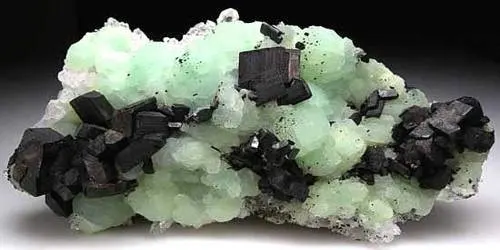

Babingtonite is the official state mineral of Massachusetts. This mineral is a dark, greenish-black or black crystal that can be found in several parts of the state, especially in Franklin County. Massachusetts is one of the few places on the planet where this mineral can be found. Babingtonite was designated the official state mineral in 1981.


The state gemstone of Massachusetts is rhodonite, as defined in 1979. This lovely gemstone can be found in several places in the state, such as the Betts Rhodonite mine, a popular place with rockhounders. This gemstone varies in colour from light pink to deep reddish-pink. Some consider this stone to be the nicest gem material in the state. This gem can also be found in the area around Plainfield.


The state fossil of Massachusetts is dinosaur tracks. Due to Massachusetts having tracks of many different species, the state designated the tracks of any dinosaur species to be the state fossil. Thousands of tracks have so far been discovered and come from a range of dinosaurs, ranging from small to large, carnivorous to herbivorous. The tracks left by these dinosaurs were left in mudflats during the Jurassic Period, about 200 million years ago.
Recommended Rockhounding Gear
While special gear is not required to find nice rocks and fossils, having the right tools will help you find more than what’s simply laying around on the open ground. Here are some of the more basic tools and safety gear for interested rockhounds.
Geological Hammer
This 22oz Pointed-Tip Rock Pick by Estwing (Amazon link) is recommended for its durability and shock-reducing grip.
A rock pick is essential when collecting mineral specimens from a hard substrate such as stone. The pick’s handle is shock-resistant, making it more comfortable for use for longer times in the field.
Geology Pick
The Geology pick by Estwing (Amazon link) is a good choice for those starting out in the hobby as well as seasoned professionals.
The hammer comes with a pointed tip on one side of the head and a chiseled end on the other. This pick is good for excavating interesting mineral and fossil specimens.
Mini Shovel
The Mini D-Handle Round Point Shovel by Stanley (Amazon link) pairs convenience with durability. Especially in areas of soft material such as sand or clay, it is nice to have a sturdy shovel that is easy to carry.
The D-shaped handle gives you more leverage when digging on your knees, which is something that similarly sized standard-handled shovels wouldn’t provide.
Heavy Duty Work Gloves by Ironclad
Working with your hands in rockhounding environments can be rough; it is easy to get cuts or abrasions when in the field. Protecting your hands is important, especially while working with sharp or abrasive rocks.
The Heavy Duty Work Gloves by Ironclad (Amazon link) protect your hands from sharp rocks and tools. They are machine washable, highly abrasion resistant, and durable.
Safety Glasses
Eye protection is a must when breaking up a rock or any sort of work where debris could cause injury to your eyes.
The 3M Safety Glasses (Amazon link) are anti-fog and have a corded earplug system, as well as a removable foam gasket. The clear, scratch-resistant lenses shield the eyes against harmful ultraviolet light as well as prevent eye injury from flying rock chips.
First Aid Kit
With its 299 pieces, the Only Emergency First Aid Kit (Amazon link) is a good one for rockhounds. Of course, it’s best to avoid injuring yourself but if things go wrong it’s good to be prepared.
Some of the items found in the kit include fabric and plastic bandages, painkillers, gauze and pads, cold packs, wound closers, and many more.
Conclusion
There are many excellent places to rockhound in this small state, making it easy to visit nearby sites, where the geological complexity of the state offers a wide variety of nice specimens of rocks and minerals that can be uncovered, including many types of gemstones.
If you’re new to rockhounding in Massachusetts, a good place to begin is by contacting the various rock and mineral societies listed above; they can be an invaluable resource for new rockhounders.
TIP: Just like the pilgrims who were in awe of Maryland’s landscape, rockhounds today are in awe of all the amazing rocks and minerals that exist in this small state. Find out more in the article below:
15 Common Rocks & Minerals You Can Find in Massachusetts