As an Amazon Associate, I earn from qualifying purchases with no additional costs for you.


This guide covers the best places to rockhound in Utah and the rocks and minerals you are most likely to find. The sites range from the topaz slopes of the Thomas Range and the Dugway geode beds to the obsidian of the Black Rock Desert and the agate country along Highway 24.
On BLM land you can collect reasonable amounts for personal use without a permit. State Trust land needs a paid permit, some national forests need a free one, and national parks, national monuments, tribal land and state parks are off-limits.
Start at Topaz Mountain for topaz, the Dugway Geode Beds for quartz- and amethyst-lined geodes, and the Black Rock Desert for obsidian, including some snowflake obsidian. Quick tip: dinosaur bone, shark teeth and other vertebrate fossils can’t be collected on public land.
Rockhounding Regulations & Laws in Utah
Utah’s collecting rules come down to one question: who manages the land you are standing on? The Utah Geological Survey keeps a summary of the collecting rules for every major land manager, and it is worth checking before each trip.
These are the rules that matter most for a personal collecting trip:
- BLM land: reasonable amounts of rocks, minerals and common invertebrate or plant fossils for personal use, with no permit. Petrified wood is limited to 25 pounds plus one piece per person per day, and 250 pounds per year.
- US Forest Service: small amounts for personal use are allowed, but some forests, such as Manti-La Sal National Forest, require a free collecting permit. Check with the ranger district before you go.
- State Trust land: a paid rockhounding permit is required ($25 for an individual or family). It allows 25 pounds plus one piece per person per day, up to 250 pounds a year, by hand only.
- Private land and mining claims: you need the landowner’s or claim holder’s permission. Don’t collect on marked claims.
- No collecting: national parks, national monuments, wildlife refuges, tribal land, military land, dam sites, and Utah state parks, including Escalante Petrified Forest State Park.
- Never collectable on public land: vertebrate fossils, including dinosaur bones and tracks and shark teeth, and archaeological artifacts such as arrowheads.
- Commercial collecting: selling what you find requires a permit, lease or license from the land manager.
State Trust land is the rule visitors most often miss, because trust parcels are scattered through BLM country. Carry your permit while you collect, since collecting on trust land without one counts as trespassing.
Use this guide as a starting point, not a final authority. Follow posted signage, and always get the landowner’s permission before collecting on private property.
Access rules and land ownership change over time, so confirming that collecting is currently allowed — and whether a permit is required — is your responsibility. Where coordinates are listed, treat them as a general reference only. How to Find Rocks is not responsible for the accuracy of the information here or for any outcome resulting from its use.
Best Rockhounding Sites in Utah
These eight sites give the best mix of public access and reliable finds. The volcanic ranges of western Utah hold the topaz, geodes, wonderstone and obsidian, while the badlands along Highway 24 in Wayne County bring agate and jasper.

The map below plots every site from the tables in this guide. Tap a point to see what you can find there and to start navigation.
The table shows who manages each site and where it is. Details on what to find and how to get there follow below it.
| Site | Access | GPS Coordinates |
|---|---|---|
| Topaz Mountain | Public (BLM) | 39.708927, -113.103390 |
| Dugway Geode Beds | Public (BLM) | 39.894156, -113.136778 |
| Vernon Hills | Public (BLM and private claims) | 40.102160, -112.357070 |
| Black Spring (Black Rock Desert) | Public (BLM) | 38.769307, -112.832053 |
| U-Dig Fossils (private quarry — fee required) | Private | 39.354694, -113.278767 |
| Wah Wah Mountains (general area) | Public (BLM) | 38.44, -113.56 |
| Marysvale (general area) | Public (BLM and national forest) | 38.44, -112.24 |
| Blue Valley | Public (BLM) | 38.359644, -110.836883 |


Topaz Mountain
Topaz Mountain in the Thomas Range of Juab County is Utah’s best-known collecting site and the home of the state gem. Topaz forms in cavities in the rhyolite and also lies loose in the washes and on the slopes, with hematite, calcite and spessartine garnet and occasional beryl and fluorite.
The crystals are amber when you find them but fade to clear in sunlight, so keep good ones wrapped up. Most people dig on the south slope of the mountain.
From Delta, drive north on US 6 to a point about 5 miles southwest of Lynndyl, then follow Highway 174 (Brush Wellman Road) about 37 miles to the signed Topaz Mountain road. There is no water and there are no services in the area.
Dugway Geode Beds
The Dugway Geode Beds are the site that made Utah famous with geode collectors. The geodes are dark gray, round and usually 2 to 4 inches across, and inside they are lined with clear quartz, purple amethyst or pink quartz.
Dig in the previously worked areas, where the soft gray material is easiest to move. Never tunnel: the walls can collapse at any time, and tunneling isn’t allowed.
From SR-36, turn onto the old Pony Express Road at the Faust station and follow it about 50 miles to the signed Geode Bed turnoff, then drive about 2 miles on an unimproved road. The beds are public land managed by the BLM Fillmore Field Office.
Vernon Hills
The Vernon Hills in Tooele County are the classic source of Utah wonderstone, a banded volcanic rock with folded stripes of cream, yellow-brown and maroon. Large wonderstone outcrops stand in the hills, and the ground around them has plenty of loose pieces to collect.
From Vernon, continue 4.5 miles south on SR-36 to a dirt road just west of the railroad tracks, follow it north for 1.7 miles to a bend and then 0.4 miles to the end of the road, where the wonderstone piles lie. A private claim lies in the area, so skip marked claims and piles with signs of recent mining, and note that four-wheel drive is recommended because the road can be muddy.
Black Spring (Black Rock Desert)
The Black Rock Desert of Millard County is a volcanic field known for obsidian, including snowflake obsidian. At Black Spring, on BLM land, obsidian lies on the ground in every direction from the parking area.
Most pieces are black and 1/2 to 6 inches across, while reddish-brown and snowflake obsidian turn up less often. From Delta, take US 6/50 west to SR-257, drive about 43 miles south to the BLM sign for Kanosh, then follow the dirt road about 6 miles east to the Black Spring sign.
The Cudahy Mine area just southwest of the spring is private land and state trust sections adjoin the spring, so stay on the BLM ground around it.
U-Dig Fossils
U-Dig Fossils is a private, pay-to-dig trilobite quarry in the Wheeler Shale near Antelope Springs, west of Delta. You split the shale to find Cambrian trilobites and other marine fossils, and you keep what you find.
The quarry is open from spring to fall, Monday to Saturday, and closes for the winter. It charges a fee per person depending on age and digging time. It’s an easy family trip, and any vehicle can handle the signed gravel road from US 6/50.
Wah Wah Mountains
The remote Wah Wah Mountains of Beaver County are mostly BLM land. Here you can realistically find garnet, hematite, galena and pyrite, with occasional topaz and fluorite.
The range lies west of Frisco, and Highway 21 is the only paved route in, so plan on dirt roads beyond it.
Marysvale
Marysvale, a small old mining town on Highway 89 in Piute County, packs a lot of material into a small area. Fluorite, amethyst, selenite, quartz and calcite are all common here, with rarer opal and cinnabar.
Marysvale Canyon, about 2.8 miles north of town on US 89, is a BLM site where gas pockets in the hard rhyolite hold amethyst crystals up to an inch long.
Blue Valley
Blue Valley, along Highway 24 about 10 miles east of Caineville in Wayne County, is the place to look for Utah’s rarer blue-banded agate. The surrounding badlands also give up black, banded, moss and plume agates and jasper.
Search the BLM land along the highway and in the low hills, and watch for traffic at roadside pull-offs.
Other Notable Spots
These smaller spots are worth adding to a trip once you have worked the sites above.
The hills along Highway 24 west of Caineville are BLM land with agate, chert, jasper and petrified wood. Agate, a former railroad stop in Grand County, sits on state trust land where chert weathers out of the surrounding sedimentary rocks.
| Site | GPS Coordinates | Common Rocks & Minerals |
|---|---|---|
| Highway 24 pass west of Caineville (approximate) | 38.252500, -111.103800 | Agate, chert, jasper, petrified wood |
| Agate, Grand County (State Trust land — rockhounding permit required) | 39.014453, -109.243597 | Chert |
At the Highway 24 pass, 8.5 miles west of Caineville, collecting starts on the north side of the road and continues up the hillslopes. Stay on the BLM ground, because a state trust land parcel lies just to the west.
Common Rocks & Minerals You Can Find in Utah
GPS coordinates are a general reference only — always confirm access rules and land status before you go.
Utah’s finds come from three settings: the rhyolite volcanic ranges of the west, the old mining districts scattered across the state, and the sedimentary plateaus of the south and east.

The headline finds are Topaz Mountain topaz, Dugway geodes, Black Rock obsidian, Vernon Hills wonderstone and trilobites, with agate, jasper and chert as everyday finds.
BTW: Do you want to know more about rock and mineral identification? The books listed below are the best ones you can find on the internet (Amazon links):
- Smithsonian Handbooks: Rocks & Minerals
- Gemstone & Crystal Properties (Quick Study Home)
- Ultimate Explorer Field Guide: Rocks and Minerals (National Geographic Kids)
If you are interested in checking out the best rockhounding book about rockhounding in Utah, you can find it by clicking here (Amazon link).
Rocks & Minerals
Each entry below shows how to recognize the stone and where to look for it in Utah.


Jasper
How to recognize it: Opaque even at thin edges, with a smooth waxy feel and solid red, yellow, brown or green colors, often with swirls or spots.
In Blue Valley, jasper weathers out of the badlands along Highway 24 together with several kinds of agate.
| Location | GPS Coordinates |
|---|---|
| Blue Valley | 38.359644, -110.836883 |
| Highway 24 pass west of Caineville (approximate) | 38.252500, -111.103800 |


Dugway Geodes
How to recognize it: Round, lumpy rocks with a plain, rough outside that often feel lighter than they look when hollow.
Dugway geodes are lined with clear quartz, purple amethyst or pink quartz, and the beds also produce thundereggs.
| Location | GPS Coordinates |
|---|---|
| Dugway Geode Beds | 39.894156, -113.136778 |


Agate
How to recognize it: Translucent when held up to light, with a waxy shine and banded, lace or moss-like patterns inside.
Black, banded, moss and plume agates are the usual finds; blue-banded agate is rarer and is the Blue Valley specialty.
| Location | GPS Coordinates |
|---|---|
| Blue Valley | 38.359644, -110.836883 |
| Highway 24 pass west of Caineville (approximate) | 38.252500, -111.103800 |


Wonderstone
How to recognize it: Banded volcanic rock (rhyolite) with folded, wavy stripes of cream, yellow-brown and maroon, opaque and fine-grained like jasper.
Utah’s classic wonderstone comes from the Vernon Hills, where large banded outcrops shed plenty of loose pieces.
| Location | GPS Coordinates |
|---|---|
| Vernon Hills (BLM and private claims) | 40.102160, -112.357070 |


Fossils
How to recognize it: Regular shapes that rocks do not make on their own: shells, spirals, ribbed or segmented outlines, teeth, or the imprint of a leaf or bone.
Utah’s collectible fossils are mostly invertebrates and plants, and the Wheeler Shale at U-Dig is known for Cambrian trilobites.
| Location | GPS Coordinates |
|---|---|
| U-Dig Fossils (private quarry — fee required) | 39.354694, -113.278767 |


Chert
How to recognize it: Dull to waxy, fine-grained stone in gray, tan, brown or black that breaks with smooth, curved, sharp edges; often found as nodules or layers in limestone.
High-quality chert weathers out of the sedimentary rocks of Grand County.
| Location | GPS Coordinates |
|---|---|
| Agate, Grand County (State Trust land — rockhounding permit required) | 39.014453, -109.243597 |
| Highway 24 pass west of Caineville (approximate) | 38.252500, -111.103800 |
The San Rafael Swell in Emery County, which is mostly BLM land, is another good area.


Obsidian
How to recognize it: Natural volcanic glass: glossy, usually black, and it breaks with smooth, curved, razor-sharp edges.
Utah is one of the best places in the US for snowflake obsidian, black glass dotted with whitish-gray “snowflakes”.
The best obsidian comes from Black Spring in the Black Rock Desert of Millard County (see Best Sites), where it lies on the ground around the spring.
| Location | GPS Coordinates |
|---|---|
| Black Spring (Black Rock Desert) | 38.769307, -112.832053 |


Birdseye Marble
How to recognize it: Not a true marble but a dense cream to gray limestone sprinkled with small round, eye-like spots, and a drop of vinegar or dilute acid makes it fizz.
Fossil algae give Birdseye marble its round “bird’s eye” spots, and the stone has long been prized for decorative work and fine masonry.
The stone takes its name from the town of Birdseye in Utah County, near the old quarries. You can find specimens along Forest Service Road 126 just inside the Manti-La Sal National Forest boundary, where a free Forest Service permit is required.


Petrified Wood
How to recognize it: Wood turned to stone that feels much heavier than real wood, with growth rings, bark texture or wood grain still visible, usually in brown, gray, red or yellow.
Silicified wood is common in southern Utah, where it weathers out with agate and jasper.
| Location | GPS Coordinates |
|---|---|
| Highway 24 pass west of Caineville (approximate) | 38.252500, -111.103800 |
The petrified wood here is tan and comes in small pieces, because the larger ones have mostly been collected already.


Topaz
How to recognize it: Very hard, glassy crystals that scratch quartz, colorless, pale blue or sherry-colored, heavier than quartz and splitting cleanly across the crystal.
Topaz is Utah’s state gem: most crystals are amber when found and fade to clear in the sun, and they are often still attached to rhyolite.
| Location | GPS Coordinates |
|---|---|
| Topaz Mountain | 39.708927, -113.103390 |
Topaz also turns up occasionally on BLM land in the Wah Wah Mountains.

Garnet
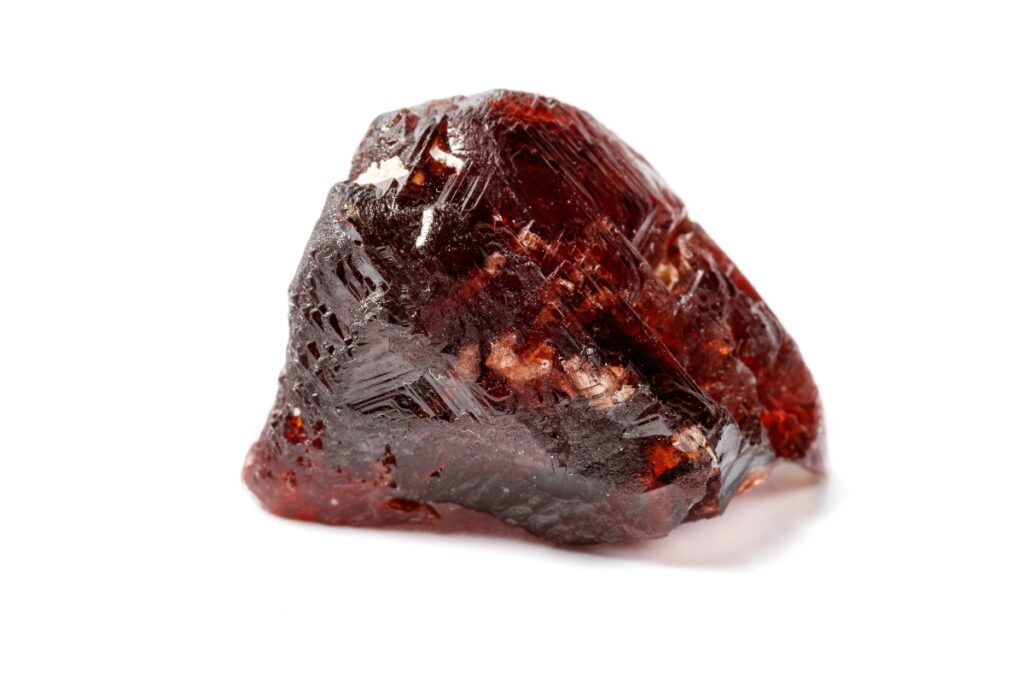
How to recognize it: Glassy, rounded crystals with many flat faces, usually deep red to orange.
At Topaz Mountain, small spessartine garnet crystals sit in the rhyolite alongside the topaz.
| Location | GPS Coordinates |
|---|---|
| Topaz Mountain | 39.708927, -113.103390 |
Garnet also turns up on BLM land in the Wah Wah Mountains of Beaver County.


Galena
How to recognize it: Very heavy, lead-gray and metallic, often in shiny cubes that break into smaller cubes, and soft enough to scratch with a knife.
Galena, the lead ore behind much of Utah’s silver mining history, usually occurs with other ore minerals.
It is common on BLM land in the Wah Wah Mountains of Beaver County. It is a lead mineral, so wash your hands after handling it.


Pyrite
How to recognize it: Brassy, metallic “fool’s gold” that is hard and brittle, often in perfect cubes, and leaves a greenish-black streak instead of gold’s yellow.
Pyrite is as common in Utah as anywhere, so check whether that glitter is pyrite before you call it gold.
Look for it on BLM land in the Wah Wah Mountains of Beaver County.


Fluorite
How to recognize it: Glassy cubes in purple, green, yellow or colorless, soft enough to scratch with a knife, splitting into flat, triangular-faced pieces, and many specimens glow under UV light.
Fluorite is common in the volcanic ranges and mining districts of western and southern Utah.
| Location | GPS Coordinates |
|---|---|
| Topaz Mountain | 39.708927, -113.103390 |
Fluorite is only an occasional find at Topaz Mountain. Marysvale is the better fluorite area, and fluorite also turns up occasionally in the Wah Wah Mountains.


Quartz
How to recognize it: Glassy and hard enough to scratch glass, usually clear to white, often in six-sided crystals with pointed tips, breaking with curved, shell-like surfaces.
Clear quartz crystals line many Dugway geodes, and quartz is common across Utah’s volcanic and mining districts.
| Location | GPS Coordinates |
|---|---|
| Dugway Geode Beds | 39.894156, -113.136778 |
Marysvale is another good place to look for quartz crystals.


Amethyst
How to recognize it: Purple quartz, from pale lilac to deep violet, in glassy six-sided crystals or crystal-lined pockets, hard enough to scratch glass.
Many Dugway geodes are lined with amethyst.
| Location | GPS Coordinates |
|---|---|
| Dugway Geode Beds | 39.894156, -113.136778 |
Marysvale Canyon (see Best Sites) is the other good amethyst stop.


Hematite
How to recognize it: Heavy, metallic gray to black or dull red iron ore that always leaves a reddish-brown streak; the specular variety glitters with flat, mirror-like flakes.
Hematite is a common companion of topaz in the Thomas Range.
| Location | GPS Coordinates |
|---|---|
| Topaz Mountain | 39.708927, -113.103390 |
It is also common in the Wah Wah Mountains of Beaver County.


Calcite
How to recognize it: Usually white, colorless or honey-colored and soft enough to scratch with a knife; it breaks into slanted, box-like blocks and fizzes in a drop of vinegar or dilute acid.
Calcite is a common companion of topaz at Topaz Mountain.
| Location | GPS Coordinates |
|---|---|
| Topaz Mountain | 39.708927, -113.103390 |
Marysvale and the Tushar Mountains, in Fishlake National Forest, are the other main areas, and some Tushar calcite glows under UV light.
Other Notable Rocks & Minerals in Utah
Utah has plenty of other minerals that are either rare or only locally common. These are the ones worth knowing about.
Red beryl is Utah’s most famous rarity. Small red beryl crystals occur in the Thomas Range around Topaz Mountain, but finds are few.
Utah red beryl ranges from light pink to deep red, in flat, elongated or six-sided crystals, and it is often attached to garnet, topaz and hematite.
Marysvale has selenite, opal and cinnabar, a red mercury ore you should handle with gloves and never heat.
State Rock, Mineral, Gem, Stone & Fossil of Utah
Utah’s state rock, mineral, gem, stone and fossil are all set out in Utah Code 63G-1-601.
| Symbol | Name | Designated |
|---|---|---|
| State rock | Coal | 1991 |
| State mineral | Copper | 1994 |
| State gem | Topaz | 1969 |
| State stone | Honeycomb calcite | 2021 |
| State fossil | Allosaurus | 1988 |
Coal was chosen for its economic importance to the state, and copper for its long historical, economic and environmental impact on Utah. Topaz is the state gem largely because Utah’s crystals are so well formed and of such good quality.
Honeycomb calcite, a honey-colored stone with a honeycomb pattern, comes only from Duchesne County. The state fossil, Allosaurus, was a large meat-eating dinosaur up to about 39 feet long that lived about 155 to 145 million years ago.
Rockhounding Clubs in Utah
Utah’s clubs run regular field trips, which are the easiest way onto good collecting ground. The Utah Geological Survey keeps a longer list of rockhounding clubs in Utah.
- Beehive Rock and Gem Club — a good place to meet other rockhounds, join field trips and learn to cut, polish and display your finds.
- Cache Rock & Gem Club — a Logan-area club with a rock show, field trips, and rock saws, cabbing machines and polishing stations members can use for a small fee.
- Southern Utah Rock Club — a non-profit promoting mineral study, collecting, lapidary and jewelry making through meetings, lectures, displays and field trips; no membership is needed to attend meetings.
Recommended Rockhounding Gear
While special gear is not required to find nice rocks and fossils, having the right tools will help you find more than what’s simply laying around on the open ground. Here are some of the more basic tools and safety gear for interested rockhounds.
Geological Hammer
This 22oz Pointed-Tip Rock Pick by Estwing (Amazon link) is recommended for its durability and shock-reducing grip.
A rock pick is essential when collecting mineral specimens from a hard substrate such as stone. The pick’s handle is shock-resistant, making it more comfortable for use for longer times in the field.
Geology Pick
The Geology pick by Estwing (Amazon link) is a good choice for those starting out in the hobby as well as seasoned professionals.
The hammer comes with a pointed tip on one side of the head and a chiseled end on the other. This pick is good for excavating interesting mineral and fossil specimens.
Mini Shovel
The Mini D-Handle Round Point Shovel by Stanley (Amazon link) pairs convenience with durability. Especially in areas of soft material such as sand or clay, it is nice to have a sturdy shovel that is easy to carry.
The D-shaped handle gives you more leverage when digging on your knees, which is something that similarly sized standard-handled shovels wouldn’t provide.
Heavy Duty Work Gloves by Ironclad
Working with your hands in rockhounding environments can be rough; it is easy to get cuts or abrasions when in the field. Protecting your hands is important, especially while working with sharp or abrasive rocks.
The Heavy Duty Work Gloves by Ironclad (Amazon link) protect your hands from sharp rocks and tools. They are machine washable, highly abrasion resistant, and durable.
Safety Glasses
Eye protection is a must when breaking up a rock or any sort of work where debris could cause injury to your eyes.
The 3M Safety Glasses (Amazon link) are anti-fog and have a corded earplug system, as well as a removable foam gasket. The clear, scratch-resistant lenses shield the eyes against harmful ultraviolet light as well as prevent eye injury from flying rock chips.
First Aid Kit
With its 299 pieces, the Only Emergency First Aid Kit (Amazon link) is a good one for rockhounds. Of course, it’s best to avoid injuring yourself but if things go wrong it’s good to be prepared.
Some of the items found in the kit include fabric and plastic bandages, painkillers, gauze and pads, cold packs, wound closers, and many more.
FAQ About Rockhounding in Utah
A few questions come up again and again from rockhounds planning a Utah trip.
Do I need a permit to collect rocks in Utah?
Not on BLM land for personal, non-commercial collecting. State Trust land requires a paid rockhounding permit, some national forests require a free permit, and private land needs the owner’s permission.
What rare rocks can you find in Utah?
Dugway geodes and thundereggs, Vernon Hills wonderstone, blue-banded agate, snowflake obsidian, fine chert, petrified wood and fossils are the rocks collectors travel for. Jasperized dinosaur bone is famous too, but as a vertebrate fossil it can only be collected on private land.
What rare minerals can you find in Utah?
Red beryl tops the list, followed by topaz, garnet, opal, amethyst, fluorite and selenite. Most of these turn up at several sites, but gem red beryl comes almost only from a private claim in the Wah Wah Mountains.
What is the most famous rock or mineral found in Utah?
Red beryl: it is extremely rare, Utah’s crystals are of exceptional quality, and they are highly valuable. Among finds you can dig yourself, Topaz Mountain topaz and Dugway geodes are the best known.
Conclusion
Utah is one of the few states where you can realistically find world-class material yourself. Topaz Mountain topaz, Dugway geodes and Black Rock Desert obsidian are all on open public land.
Carry far more water than you think you need, because the best desert sites are remote, with no services.
If you are interested in checking out the best rockhounding tools, you can find them by clicking here (Amazon link).
| Research Behind This Guide |
|---|
This guide was compiled and edited by the How to Find Rocks team. It consolidates, fact-checks, and builds on original research and field reporting first published on this site by the following subject-matter expert(s): Lauren Ballejos — Rockhounding enthusiast, member of the Flagg Mineral Foundation (FMF), and professional content writer with a growing personal rock collection. See all articles by Lauren → |