
As an Amazon Associate, I earn from qualifying purchases with no additional costs for you.

This guide covers the best places to rockhound in Michigan, from the Petoskey stone beaches of the Lower Peninsula to the agate shores and copper country of the Upper Peninsula, and the rocks and minerals you are most likely to find.
State parks, state forests and the Great Lakes shoreline below the high-water mark allow up to 25 pounds of rocks, minerals and invertebrate fossils per person per year. Isle Royale, Sleeping Bear Dunes and Pictured Rocks are look-only.
Start at Petoskey State Park or Fisherman’s Island for Petoskey stones, then head north to Grand Marais and Muskallonge Lake for Lake Superior agates and glowing Yooperlites. Go in spring, after the ice has churned up fresh stones.
Rockhounding Regulations & Laws in Michigan
In Michigan, the land manager decides what you can take home. The Michigan Geological Survey sums up the rules for each type of land, and state law caps collecting on state-managed ground.
- State parks, recreation areas and state forests: up to 25 pounds of rocks, minerals and invertebrate fossils per person per year, for personal, non-commercial hobby use, under the state land use rules. Collecting is not allowed in historic state parks such as Fayette.
- Great Lakes shoreline: the beach below the ordinary high-water mark is public trust land, and the same 25-pound yearly limit applies, as Michigan’s environment department (EGLE) notes.
- National parks and lakeshores: no collecting at all. The National Park Service bans taking rocks, greenstones, agates or Petoskey stones at Isle Royale, Sleeping Bear Dunes and Pictured Rocks.
- National forests: the Ottawa and Huron-Manistee let visitors pick up rock and mineral specimens for personal enjoyment without special permission or a fee, and the Hiawatha invites rockhounding on its Great Lakes beaches. Collecting is not allowed in the wilderness areas of the Ottawa and Hiawatha.
- Wildlife refuges: the Whitefish Point Unit of Seney National Wildlife Refuge bans rock collecting.
- Mine dumps and private land: most of the old rock piles in the Keweenaw and on the Marquette iron range are private, so get permission first.
- City, township and county beaches: local rules vary, so look for posted signs.
Rules change without notice, so confirm them with the managing agency before a trip.
Use this guide as a starting point, not a final authority. Follow posted signage, and always get the landowner’s permission before collecting on private property.
Access rules and land ownership change over time, so confirming that collecting is currently allowed — and whether a permit is required — is your responsibility. Where coordinates are listed, treat them as a general reference only. How to Find Rocks is not responsible for the accuracy of the information here or for any outcome resulting from its use.
Best Rockhounding Sites in Michigan
These eight sites give the best chance of a good find. The Lake Michigan beaches of the Lower Peninsula are fossil country, while the Lake Superior shore holds the agates and Yooperlites, and the Keweenaw’s old mines the copper and greenstones.
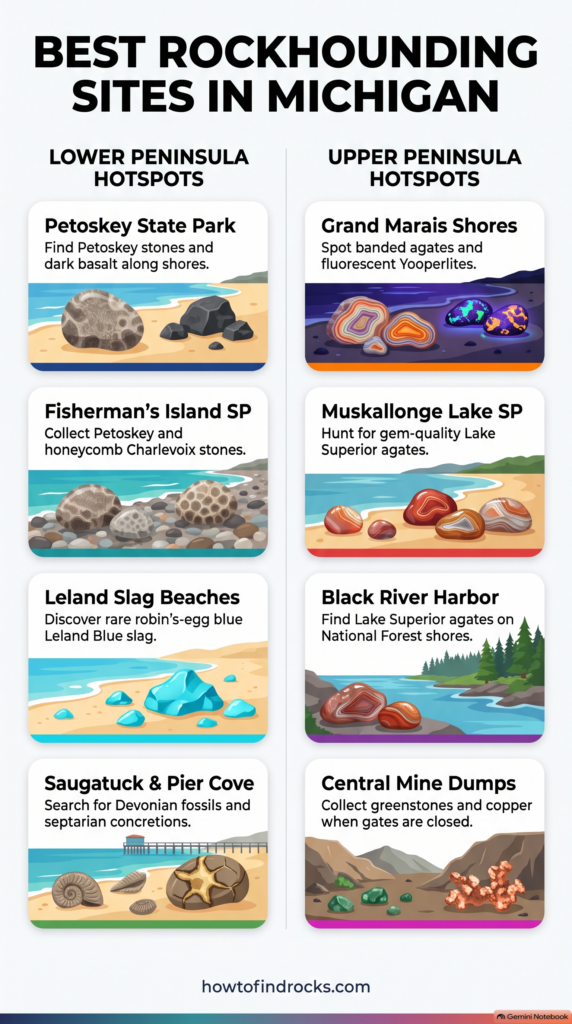
The map below plots every site from the tables in this guide. Tap a point to see what you can find there and to start navigation.
The table shows who manages each site and where it is. Details on what to find and how to get there follow below it.
| Site | Access | GPS Coordinates |
|---|---|---|
| Petoskey State Park | Public (state park) | 45.406543, -84.908581 |
| Fisherman’s Island State Park (approximate) | Public (state park) | 45.2645, -85.3610 |
| Leland (general area) | Public (local rules apply) | 45.01, -85.78 |
| Pier Cove & Saugatuck (general area) | Public (local rules apply) | 42.59, -86.23 |
| Grand Marais (general area) | Public (local rules apply) | 46.67, -85.98 |
| Muskallonge Lake State Park | Public (state park) | 46.678414, -85.628224 |
| Black River Harbor (Wild and Scenic River — no permit for personal collecting) | Public (Ottawa National Forest) | 46.664788, -90.045373 |
| Central Mine (approximate; Keweenaw County Historical Society — picking only when the gates are closed) | Private (historical society) | 47.4069, -88.2039 |
Petoskey State Park
Petoskey State Park, on Little Traverse Bay just north of Petoskey, is the classic place to start. Petoskey stones wash up all along the beach, and the rocky south end usually gives the best results.
Wet any gray stone you pick up, because dry Petoskeys look like plain limestone and the six-sided pattern only shows when they are wet. You will also find dark basalt cobbles that glaciers carried south from Lake Superior.
Fisherman’s Island State Park
Fisherman’s Island State Park, just south of Charlevoix, has miles of quieter, rocky Lake Michigan shoreline. It is one of the best places to find both Petoskey stones and the finer-patterned Charlevoix stone, another fossil coral.
Leland
Leland, on the Lake Michigan side of the Leelanau Peninsula, is the only source of Leland Blue. These blue to blue-gray glassy stones are not natural: they are slag from the Leland Iron Works, which ran in the town from 1870 to 1885.
Search the Lake Michigan beaches in and around town, where the slag keeps washing back in from the lake.
Saugatuck and Pier Cove
The Lake Michigan shore at Saugatuck is one of the best fossil areas on the southwest coast. Look for crinoids, bryozoans, brachiopods, clam fossils, stromatolites and horn, chain and Favosites corals, along with Petoskey and Charlevoix stones.
Like most Lake Michigan beaches, it also turns up quartz, chalcedony, granite pebbles and naturally tumbled beach glass, which many collectors keep alongside their stones.
A few miles south, the shore at Pier Cove is best in spring after the ice melts, when fresh fossils, gray basalt cobbles and brown septarian concretions are exposed.
Grand Marais
Grand Marais, on the Lake Superior shore of Alger County, is a classic agate town and one of the best-known places to hunt Yooperlites. Agates turn up on the beaches in town and east of it toward Muskallonge Lake.
Muskallonge Lake State Park
Muskallonge Lake State Park lies on a narrow strip of land between Muskallonge Lake and Lake Superior, east of Grand Marais. Its Lake Superior beach is a reliable agate shoreline.
Black River Harbor
Black River Harbor, in the Ottawa National Forest at the mouth of the Black River, is a good agate beach at the far western end of the Upper Peninsula. Lake Superior agates turn up in the gravel on either side of the harbor.
The harbor sits at the mouth of a federal Wild and Scenic River.
Central Mine
The Keweenaw Peninsula is Michigan’s copper country, and the waste rock piles of its old mines hold native copper, Isle Royale greenstones, calcite crystals and datolite. The Central Mine in Keweenaw County, owned by the Keweenaw County Historical Society, is known for the greenstones in its poor-rock piles.
Rockhounds still search them, as the historical society notes. According to the Keweenaw tourism bureau’s rock-picking guide, picking is allowed only when the gates are closed and no work is going on.
Other Notable Spots
These Great Lakes shorelines are also worth a stop if you are nearby.
Public Beaches & Shorelines
Petoskey stones also turn up on Beaver Island and along the shore around Traverse City.
On Lake Huron, smooth Petoskey pebbles are reported at Lakeport State Park, and Rogers City, Presque Isle and Drummond Island are limestone country, with pudding stones also turning up in the eastern Upper Peninsula. On Lake Superior, agates turn up west of Whitefish Point.
Common Rocks & Minerals You Can Find in Michigan
GPS coordinates are a general reference only — always confirm access rules and land status before you go.
Michigan’s geology is a story of ancient seas and glaciers. The Lower Peninsula sits on the sedimentary rocks of the Michigan Basin, full of Devonian fossils, while the Upper Peninsula exposes igneous and metamorphic rocks up to about 3.6 billion years old, with copper and iron deposits of world importance.
The Michigan Basin formed on an ancient Precambrian surface, and from the early Ordovician to the Jurassic it filled layer by layer with sediments on top of Cambrian sandstones. Pleistocene glaciers later scraped across the state, exposing fossils such as the Petoskey stone and spreading northern rocks south.
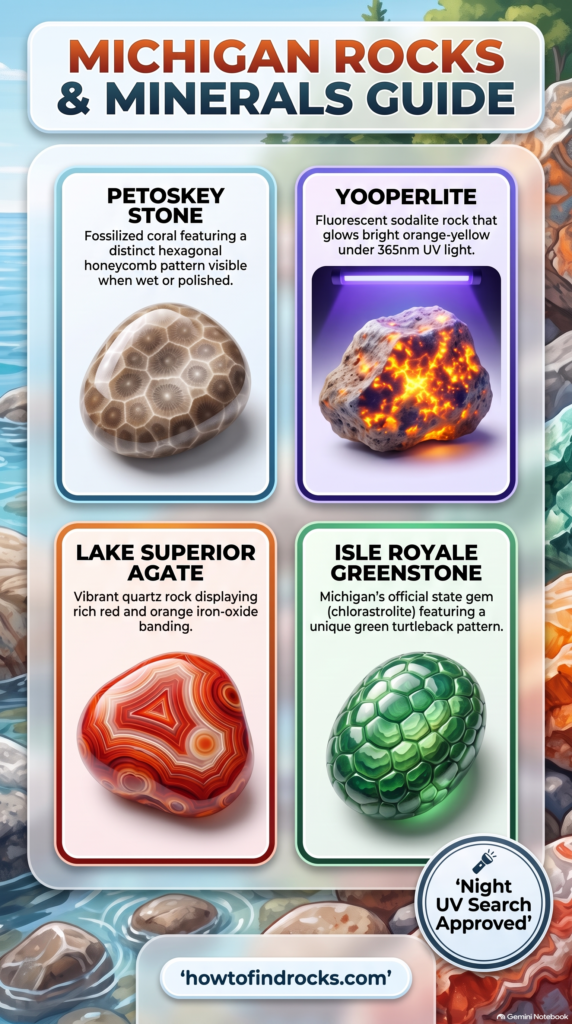
Petoskey stones and Lake Superior agates are the finds Michigan is famous for, and glowing Yooperlites have joined them since 2017. The Keweenaw adds native copper and Isle Royale greenstone, the state gem, while the Marquette range adds hematite and jaspilite.
If you would rather work from a proper field guide while you are out there, these are worth keeping in the car.
BTW: Do you want to know more about rock and mineral identification? The books listed below are the best ones you can find on the internet (Amazon links):
- Smithsonian Handbooks: Rocks & Minerals
- Gemstone & Crystal Properties (Quick Study Home)
- Ultimate Explorer Field Guide: Rocks and Minerals (National Geographic Kids)
Rocks & Minerals
Each of the ten finds below has a photo, the key signs to look for, and where to search in Michigan.

Lake Superior Agate
How to recognize it: Translucent when held up to light, with a waxy shine and banded, lace or moss-like patterns inside.
Lake Superior agate is a banded form of quartz, and iron gives it bands of red, orange, cream and white, sometimes with brown, black or gray. Agates also turn up on Lake Michigan beaches, including cloud-patterned white, gray and blue ones.
| Location | GPS Coordinates |
|---|---|
| Muskallonge Lake State Park (state park) | 46.678414, -85.628224 |
| Black River Harbor (Wild and Scenic River — no permit for personal collecting) | 46.664788, -90.045373 |
Grand Marais and the beaches east toward Whitefish Point are classic agate shoreline.

Petoskey Stone
How to recognize it: Gray to tan fossil coral that looks like plain limestone when dry; wet or polished, it shows a honeycomb of six-sided cells, each with a darker center “eye”.
Named after the town of Petoskey, the state stone is the colonial coral Hexagonaria percarinata, from a Devonian reef in a warm sea more than 350 million years ago. Glaciers spread it across the northern Lower Peninsula, so it also turns up inland, though most of that ground is private.
| Location | GPS Coordinates |
|---|---|
| Petoskey State Park (state park) | 45.406543, -84.908581 |
| Fisherman’s Island State Park (approximate; state park) | 45.2645, -85.3610 |
Beaver Island, the shore around Traverse City and Lakeport State Park on Lake Huron are other places to look. Petoskey stones get scarcer the farther south you go, though a few reach the southwest beaches.

Yooperlite
How to recognize it: Gray, granite-like pebble that looks ordinary in daylight but shows bright orange-yellow glowing spots and veins under a 365 nm UV light.
Yooperlites are syenite rocks rich in fluorescent sodalite, identified on Lake Superior in 2017 by Erik Rintamaki, according to Pure Michigan. Hunt for them at night with a filtered 365 nm UV flashlight, since in daylight they look like any other gray pebble.
The beaches around Grand Marais and on the Keweenaw Peninsula are the best-known spots, and Yooperlites also turn up farther east along the Lake Superior shore. Bring a headlamp, warm layers and good footwear, because wet shoreline rocks are slippery in the dark. In state parks, only registered campers may stay after 10 p.m., so book a campsite for a night hunt there.
BTW: If you are looking for the best UV light for rockhounding, find out my picks below (Amazon links):
- BEST OPTION: Convoy 8+ 365nm UV LED Flashlight with Patented Glass Filter
- BUDGET OPTION: Karrong Rechargeable 1200 Lumen 395nm UV Flashlight
- OPTION FOR INDOOR USAGE: Prime Upgraded Big Chip 396nm UV

Limestone
How to recognize it: Usually gray, cream or tan and fine-grained, often holding fossils; a drop of vinegar or dilute acid makes it fizz.
Michigan’s Devonian limestones hold most of the fossils that wash up on its beaches.
The Lake Huron shore around Rogers City, Presque Isle and Drummond Island is limestone country.

Basalt
How to recognize it: Dark gray to black, heavy and fine-grained volcanic rock, often dotted with small round gas holes (vesicles).
Michigan’s basalt is the iron- and magnesium-rich lava of the Keweenaw, which hosts the state’s native copper, agates and greenstones. Glaciers carried basalt cobbles south, so gray basalt also turns up on Lake Michigan beaches.
| Location | GPS Coordinates |
|---|---|
| Petoskey State Park (state park) | 45.406543, -84.908581 |
On the Keweenaw Peninsula, basalt is the bedrock itself. On Lake Michigan, look for basalt cobbles after the spring ice-out.
Isle Royale Greenstone
How to recognize it: Small, rounded green to blue-green pebbles, rarely over an inch, with a “turtleback” pattern of radiating fibers that shimmers as you turn the stone.
Michigan’s state gem is chlorastrolite, a variety of pumpellyite that grew in the gas holes of Keweenaw lava flows, as Michigan Tech explains. Gem-quality stones come almost only from the Lake Superior region.
| Location | GPS Coordinates |
|---|---|
| Central Mine (approximate; Keweenaw County Historical Society — picking only when the gates are closed) | 47.4069, -88.2039 |
Weathered greenstones also wash out of the basalt onto Keweenaw beaches in Houghton and Keweenaw counties. They are getting scarcer, so expect small, bean-sized pebbles.

Copper
How to recognize it: Native copper is copper-red to brown, soft and bendable, often tarnished green; copper ores show bright green (malachite) or blue (azurite) colors.
The Keweenaw holds huge deposits of native copper, metal that is already pure rather than locked in ores, often as crystallized specimens. The best searching is on the rock piles outside the old mines, where it often comes with calcite and datolite.
| Location | GPS Coordinates |
|---|---|
| Central Mine (approximate; Keweenaw County Historical Society — picking only when the gates are closed) | 47.4069, -88.2039 |

Calcite
How to recognize it: Usually white, colorless or honey-colored and soft enough to scratch with a knife; it breaks into slanted, box-like blocks and fizzes in a drop of vinegar or dilute acid.
Michigan calcite comes mainly from the Keweenaw copper mines, where clear to white crystals often hold flecks of native copper.
On public ground, search the Traverse Bay area and the Lake Huron shore around Presque Isle and Drummond Island.

Hematite
How to recognize it: Heavy, metallic gray to black or dull red iron ore that always leaves a reddish-brown streak; the specular variety glitters with flat, mirror-like flakes.
Hematite is the iron ore of the Marquette iron range around Ishpeming and Negaunee, in black, red or steel-gray. The local favorite is specular hematite, or specularite, a shiny, flaky form of the same iron oxide.
On public ground, look for hematite along the Lake Superior shore.
Leland Blue
How to recognize it: Man-made glassy slag in robin’s-egg blue to blue-gray, green or purple, often pitted with gas bubbles and swirls.
Leland Blue, also called blue slag, is not a natural mineral but man-made slag from the Leland Iron Works, which smelted iron in the town from 1870 to 1885. The waste was dumped into Lake Michigan and slowly washes back onto the local beaches, so no new stones are being made.
Look on the Lake Michigan beaches in and around Leland, the only place the stones come from.
Other Notable Rocks & Minerals in Michigan
Beyond the ten finds above, chert is found in Leelanau and Charlevoix counties and around Saginaw Bay, including a reddish chert north of Norwood.
Michigan State Stone, Gem & Fossil
Michigan’s geological symbols celebrate its Great Lakes finds and its Ice Age past. The State of Michigan lists all three.
| Symbol | Official Choice | Adopted |
|---|---|---|
| State stone | Petoskey stone | 1965 |
| State gem | Chlorastrolite (Isle Royale greenstone) | 1972 |
| State fossil | Mastodon | 2002 |
Mastodons (Mammut americanum) and mammoths roamed Michigan in the Ice Age, and mastodon fossils turn up across the Great Lakes region and the Upper Midwest. The only known mastodon trackway was found near Saline in Washtenaw County.
A mastodon display can be seen at the University of Michigan Museum of Natural History in Ann Arbor. For other Michigan fossils and minerals, visit the Cranbrook Institute of Science, the Besser Museum or the Gitche Gumee Agate & History Museum.
Michigan’s rocks also hold Devonian fish fossils such as placoderms and acanthodians, and fossil ferns and scale trees are common.
Recommended Rockhounding Gear
While special gear is not required to find nice rocks and fossils, having the right tools will help you find more than what’s simply laying around on the open ground. Here are some of the more basic tools and safety gear for interested rockhounds.
Geological Hammer
This 22oz Pointed-Tip Rock Pick by Estwing (Amazon link) is recommended for its durability and shock-reducing grip.
A rock pick is essential when collecting mineral specimens from a hard substrate such as stone. The pick’s handle is shock-resistant, making it more comfortable for use for longer times in the field.
Geology Pick
The Geology pick by Estwing (Amazon link) is a good choice for those starting out in the hobby as well as seasoned professionals.
The hammer comes with a pointed tip on one side of the head and a chiseled end on the other. This pick is good for excavating interesting mineral and fossil specimens.
Mini Shovel
The Mini D-Handle Round Point Shovel by Stanley (Amazon link) pairs convenience with durability. Especially in areas of soft material such as sand or clay, it is nice to have a sturdy shovel that is easy to carry.
The D-shaped handle gives you more leverage when digging on your knees, which is something that similarly sized standard-handled shovels wouldn’t provide.
Heavy Duty Work Gloves by Ironclad
Working with your hands in rockhounding environments can be rough; it is easy to get cuts or abrasions when in the field. Protecting your hands is important, especially while working with sharp or abrasive rocks.
The Heavy Duty Work Gloves by Ironclad (Amazon link) protect your hands from sharp rocks and tools. They are machine washable, highly abrasion resistant, and durable.
Safety Glasses
Eye protection is a must when breaking up a rock or any sort of work where debris could cause injury to your eyes.
The 3M Safety Glasses (Amazon link) are anti-fog and have a corded earplug system, as well as a removable foam gasket. The clear, scratch-resistant lenses shield the eyes against harmful ultraviolet light as well as prevent eye injury from flying rock chips.
First Aid Kit
With its 299 pieces, the Only Emergency First Aid Kit (Amazon link) is a good one for rockhounds. Of course, it’s best to avoid injuring yourself but if things go wrong it’s good to be prepared.
Some of the items found in the kit include fabric and plastic bandages, painkillers, gauze and pads, cold packs, wound closers, and many more.
FAQ About Rockhounding in Michigan
These are the questions that come up most often about collecting in Michigan.
How many rocks can you take from Michigan beaches?
Up to 25 pounds of rocks, minerals and invertebrate fossils per person per year from state parks, state forests and the Great Lakes shoreline below the high-water mark. National parks and lakeshores such as Isle Royale, Sleeping Bear Dunes and Pictured Rocks allow no collecting at all.
Where is the best place to find Petoskey stones?
The rocky beaches around Petoskey and Charlevoix, including Petoskey State Park and Fisherman’s Island State Park. Look in spring or after a storm, and wet any gray stone to reveal the pattern.
What is the most famous rock in Michigan?
The Petoskey stone, the state stone since 1965. Its six-sided coral pattern makes it the most sought-after find, ahead of Lake Superior agates, Yooperlites and Isle Royale greenstones.
Where can you find Isle Royale greenstones?
On the old mine dumps of the Keweenaw Peninsula, such as the Central Mine, and on Keweenaw beaches.
Can you collect rocks on Isle Royale?
No. Isle Royale is a national park, so all its rocks, greenstones and copper are look-only, and the park is closed to visitors from November 1 to April 15.
What are Yooperlites?
Syenite rocks rich in fluorescent sodalite that glow orange and yellow under UV light. They are found mainly along Lake Superior in the Upper Peninsula, especially around Grand Marais and the Keweenaw.
When is the best time to go rock hunting in Michigan?
Spring, right after the ice breaks up, and the days after strong storms. Waves and ice push fresh stones onto the beach, while calm summer weekends tend to leave picked-over shorelines.
Can you collect copper in Michigan?
Yes, on private mine dumps in the Keweenaw where the owner allows it, and at the Central Mine when its gates are closed.
Can you collect at Jasper Knob in Ishpeming?
Jasper Knob is a famous hill of banded red jasper and silvery hematite worth seeing, but its collecting rules are not published, so check locally before you pick anything up.
Conclusion
Michigan is one of the few states where the best rockhounding is a walk on the beach. Petoskey stones, Lake Superior agates and Yooperlites can all be found without a shovel, and the Keweenaw adds copper and greenstones for the more adventurous.
The rule to remember is simple: 25 pounds a year on state land and below the high-water line, and nothing from the national parks and lakeshores.
| Research Behind This Guide |
|---|
This guide was compiled and edited by the How to Find Rocks team. It consolidates, fact-checks, and builds on original research and field reporting first published on this site by the following subject-matter expert(s): Lauren Ballejos — Rockhounding enthusiast, member of the Flagg Mineral Foundation (FMF), and professional content writer with a growing personal rock collection. See all articles by Lauren → |