
As an Amazon Associate, I earn from qualifying purchases with no additional costs for you.


This guide covers the best rockhounding sites in Montana, the ten rocks and minerals you are most likely to find, and the land rules that decide where you can dig.
The key legal fact: national forest and BLM land are open to hand collecting in small, personal-use amounts, and gold panning needs no permit there. State parks, state trust land, national parks and wilderness areas are off-limits, and vertebrate fossils always need a research permit.
Start with Crystal Park for amethyst and smoky quartz, the sapphire digs at Gem Mountain and Spokane Bar, and Ruby Reservoir for garnets. Agate hunters head for the Yellowstone River, the home of Montana moss agate.
Rockhounding Regulations & Laws in Montana
Montana has a great deal of public land, but the collecting rules depend on who manages the ground. Private land, mining claims and closed areas often sit right next to open ground, so check the land status before you dig.
- National forests: collecting small amounts of rocks, gems and minerals for personal use, fossil hunting and gold panning need no permit, according to the Forest Service guide for Montana’s national forests. A small sluice box needs a Notice of Intent, and a suction dredge needs Forest Service approval plus Montana DEQ and DNRC permits.
- Closed national forest areas: wilderness areas, Wild and Scenic River corridors, campgrounds, administrative sites, historic and archaeological sites, and land withdrawn from mineral entry.
- Petrified wood on national forests: you need a free-use permit. At the Gallatin Petrified Forest the free permit must be obtained in advance from the Yellowstone Ranger District and allows 20 cubic inches per person per year.
- BLM land: casual, noncommercial collecting of rocks, minerals and semiprecious gemstones is allowed. BLM rules allow up to 25 pounds of common invertebrate and plant fossils per person per day, and petrified wood up to 25 pounds plus one piece per day, with a 250-pound yearly limit.
- Fossils: vertebrate fossils such as dinosaur bones, teeth and trackways cannot be collected on federal land without a research permit. Archaeological artifacts such as arrowheads may never be collected.
- State parks and other FWP sites: Montana’s public use rules (ARM 12.12.106) prohibit damaging or possessing natural features and fossils.
- State trust land: the recreational use license does not cover collecting valuable rocks, minerals or fossils, which need a separate lease, license or antiquities permit (ARM 36.25.145).
- Rivers: Montana’s stream access law lets you use rivers and streams for recreation between the ordinary high-water marks, but not cross private land to reach them. The law does not address rock collecting, so check local rules before you take stones from a gravel bar.
- National parks: Glacier and Yellowstone are for looking only, and nothing may be collected.
- Mining claims and fee digs: never work someone else’s claim without permission. On private sapphire and garnet digs, the fee is your permission.
Rules change, and every ranger district and field office can add its own closures. Call the local office before a long trip, especially for wilderness study areas and old mining districts.
Use this guide as a starting point, not a final authority. Follow posted signage, and always get the landowner’s permission before collecting on private property.
Access rules and land ownership change over time, so confirming that collecting is currently allowed — and whether a permit is required — is your responsibility. Where coordinates are listed, treat them as a general reference only. How to Find Rocks is not responsible for the accuracy of the information here or for any outcome resulting from its use.
Best Rockhounding Sites in Montana
Montana’s finds cluster in two areas: the mineralized mountains and old mining districts of the southwest, and the agate-bearing river gravels and badlands of the east. These ten sites give the best mix of access and reliable finds.

The map below plots every site from the tables in this guide. Tap a point to see what you can find there and to start navigation.
Each site below has its own section with what you can find there, how to get there and the rules that apply.
| Site | Access | GPS Coordinates |
|---|---|---|
| Crystal Park (Beaverhead-Deerlodge National Forest — fee) | Fee | 45.486671, -113.100064 |
| Gem Mountain Sapphire Mine (private mine — fee) | Fee | 46.242856, -113.582401 |
| Spokane Bar Sapphire Mine (private mine — fee) | Fee | 46.665685, -111.811656 |
| Ruby Reservoir (BLM) | Public | 45.2263, -112.1188 |
| Delmoe Lake (Beaverhead-Deerlodge National Forest — check land status) | Public | 45.990159, -112.356928 |
| Gallatin Petrified Forest (Custer Gallatin National Forest — permit required) | Permit | 45.118949, -111.101655 |
| Mount Blackmore (Custer Gallatin National Forest — wilderness study area) | Public | 45.443916, -111.003301 |
| Yellowstone River (general area — check local rules) | Public | 46.08, -107.74 |
| Pryor Mountains (check local rules) | Public | — |
| Virginia City & Alder Gulch (general area — mostly private) | Private | 45.29, -111.95 |
Crystal Park
Crystal Park is a 220-acre Forest Service collecting area at 7,800 feet in the Pioneer Mountains of southwest Montana, in the Elkhorn Hot Springs area. Diggers find quartz crystals in gray, purple, white and smoky colors, including amethyst, scepters and double-terminated crystals.
The fee is $5 per person per day for ages 11 and up, and children 10 and under are free. You may dig with hand tools only, for up to five days per person each season, and tunneling is not allowed.
The site is open from mid-June to mid-October, depending on snow. From Dillon, take Highway 278 west for 22 miles, then follow the Pioneer Mountains Scenic Byway north for about 17 miles.
Gem Mountain Sapphire Mine
Gem Mountain is a pay-to-dig sapphire operation in the Rock Creek area west of Philipsburg, one of Montana’s best-known sapphire districts. Visitors wash and screen sapphire-bearing gravel at the washing site next to the mine, and staff show you how.
The mine also runs a year-round storefront at 201 West Broadway in Philipsburg. Rock Creek sapphires are usually heat-treated, and most treated stones turn blue, greenish blue or green.
Spokane Bar Sapphire Mine
Spokane Bar Sapphire Mine sits on a Missouri River gravel bar about 10 miles east of Helena, above Hauser Lake. You can buy bags of unsorted gravel to screen at the shop, or dig your own material in an open pit with your own tools.
Besides sapphires in blue, green, purple, pink, orange and yellow, the gravel holds garnets, quartz and moss agate. The site is family-friendly and open year-round.
Ruby Reservoir
The Ruby River drainage in Madison County is Montana’s classic garnet country, with red, orange and pink almandine garnets. The easiest public spot is the BLM recreation site on the east shore of Ruby Reservoir, about 10 miles south of Alder on Road 357.
The BLM confirms that garnets can be collected along the shoreline, where wave action and spring runoff keep concentrating them. The site is free, open year-round and managed by the BLM Dillon Field Office.
Delmoe Lake
Delmoe Lake is a reservoir east of Butte near Homestake Pass, in the granite of the Boulder Batholith on the Beaverhead-Deerlodge National Forest. Pegmatite pockets around the lake hold smoky quartz, amethyst, black tourmaline and occasional topaz.
Most of the surrounding land is national forest, but check the land status at the lake itself before you dig. Take the Delmoe Lake exit off I-90 at Homestake Pass.
Gallatin Petrified Forest
The Gallatin Petrified Forest at the south end of the Gallatin Range holds petrified wood and other plant fossils. It lies on the Custer Gallatin National Forest inside a wilderness study area, and the trailhead is at the end of Tom Miner Road next to the Tom Miner Campground.
Collecting needs a free permit obtained in advance from the Yellowstone Ranger District in Livingston, and permits are rarely available on short notice. The permit allows 20 cubic inches of petrified wood (about 3 × 3 × 2 inches) per person per year, collected only within the Gallatin Petrified Forest special management zone.
Mount Blackmore
Mount Blackmore rises above Hyalite Canyon south of Bozeman, on the Custer Gallatin National Forest. Rockhounds collect agate, opal and petrified wood here, and clear hyalite opal is found in the rock slides below nearby Hyalite Peak.
The peak lies in the Hyalite-Porcupine-Buffalo Horn Wilderness Study Area, so collect only small amounts by hand and leave no trace. Check current rules with the Custer Gallatin National Forest before you go.
Yellowstone River
The Yellowstone River Basin in southeastern Montana is the home of Montana moss agate, one of the two state gem stones. Agate and jasper weather out of the river gravels, and the area around Miles City is known for jasper.
Under Montana’s stream access law you may use the river between the ordinary high-water marks, but you may not cross private land to reach it. The law does not address rock collecting, and FWP sites ban removing natural features, so check local rules before you collect.
Pryor Mountains
The Pryor Mountains in south-central Montana offer the widest variety in the east: agate, jasper, petrified wood, geodes and fossils. The rare dryhead agate, banded in red, pink, white, black and gray, comes from the country between the Bighorn and Pryor Mountains, near the Bighorn River.
The range is a patchwork of BLM land, Custer Gallatin National Forest, Bighorn Canyon National Recreation Area and private ranches. The best-known collecting area lies in the BLM’s East Pryor Mountain Area of Critical Environmental Concern, so check local rules with the BLM Billings Field Office before you collect.
Virginia City & Alder Gulch
Alder Gulch, between Virginia City and Alder, is one of Montana’s richest historic gold districts, and Virginia City alone produced more than a million ounces. Miners’ sluice boxes there often held purple, water-worn almandine garnets, and garnets still turn up in the gravel beneath the old dredge piles.
Most of the ground is private or under claim, so collect only with the owner’s permission. The Red Rock Mine near Alder sells buckets of dredge gravel to screen for garnets.
Other Notable Rockhounding Spots in Montana
Beyond the top ten, Montana has dozens of smaller sites, from national forest gravel bars to the old mines of the Butte district. They are grouped below by access.
Public Sites
These two sites are on national forest land with exact GPS coordinates. Both lie in mining districts, so watch for claim markers before you dig.
| Site | GPS Coordinates | Common Rocks & Minerals |
|---|---|---|
| American Bar (Helena National Forest — check for mining claims) | 46.813034, -111.929179 | Garnet; topaz is a rarer find |
| Rock Creek (Lolo National Forest — check for mining claims) | 46.391091, -113.683049 | Sapphire |
Many more spots are river stretches, towns or whole counties rather than exact sites, including the Anaconda area. Agate and jasper come from the Jefferson River, Whitewater Creek in Phillips County and Cracker Box Creek in Dawson County, while gold panners work the Missouri, Clark Fork, Blackfoot, Big Hole, Bitterroot, Boulder and Yaak rivers.
Upper Rock Creek also gives quartz, but its streamside zone is withdrawn from mineral entry and closed to prospecting. Pole Creek and the South Boulder River are listed for quartz, garnet and ruby, but their exact locations and land status could not be verified, so check before you go.
Private & Restricted Sites
Some of Montana’s most famous localities are private, under claim or closed to collectors. Yogo Gulch in Judith Basin County is the source of Yogo sapphire, considered the finest precious gemstone ever found in the U.S., but it has long been worked by mining companies, so check claim and land status before you go.
The Butte District is rich in rhodochrosite, rhodonite and copper minerals, and the Emma, Badger and Parnell mines are classic localities. These are underground or urban mine sites that are not open for collecting, and the Berkeley Pit, the source of Butte turquoise, is closed to collectors as well.
Dry Cottonwood Creek in Deer Lodge County is a known sapphire locality, and Frying Pan Basin in Beaverhead County gives opal, but the land status at both could not be confirmed. Ask the county or the Beaverhead-Deerlodge National Forest before you visit.
Common Rocks & Minerals You Can Find in Montana
GPS coordinates are a general reference only — always confirm access rules and land status before you go.
Montana’s eastern half is famous for world-class dinosaur fossils and agate-bearing river gravels, while the western mountains hold mining districts rich in minerals and gemstones. The state is best known for sapphire and agate, its two official gem stones.

The headline finds are Montana sapphire, Montana moss agate and the amethyst and smoky quartz of Crystal Park, while jasper, garnet, petrified wood, fossils, opal, tourmaline and gold turn up across much of the state.
BTW: Do you want to know more about rock and mineral identification? The books listed below are the best ones you can find on the internet (Amazon links):
- Smithsonian Handbooks: Rocks & Minerals
- Gemstone & Crystal Properties (Quick Study Home)
- Ultimate Explorer Field Guide: Rocks and Minerals (National Geographic Kids)
If you are interested in checking out the best book about rockhounding in Montana, you can find it by clicking here (Amazon link).
Rocks & Minerals
Each entry below shows how to recognize the stone and where to look for it in Montana.


Agate
How to recognize it: Translucent when held up to light, with a waxy shine and banded, lace or moss-like patterns inside.
Montana moss agate, a state gem stone since 1969, is translucent gray to clear with black, moss-like inclusions of manganese and iron oxides, often with splashes of reddish orange.
| Location | GPS Coordinates |
|---|---|
| Mount Blackmore (Custer Gallatin National Forest — wilderness study area) | 45.443916, -111.003301 |
The best agate country is the Yellowstone River Basin in the southeast, where Montana moss agate weathers out of the river gravels. Agates also come from the Pryor Mountains, the Jefferson River, Whitewater Creek in Phillips County and Cracker Box Creek in Dawson County.
The rarer dryhead agate, banded in red, pink, white, black and gray, is found between the Bighorn and Pryor Mountains and around Hardin, and some dryhead agates form as geodes. Little new dryhead material reaches the market today.
If you buy Montana agates rather than find them, learn how to tell real stones from fakes in our agate guide.


Jasper
How to recognize it: Opaque even at thin edges, with a smooth waxy feel and solid red, yellow, brown or green colors, often with swirls or spots.
Montana jasper is common alongside agate in the river gravels of the east and southwest.
Look for jasper along the Yellowstone River, especially around Miles City, and along the Missouri and Jefferson rivers and in Madison County. The Pryor Mountains and the Bighorn Canyon area also give jasper, but Bighorn Canyon National Recreation Area itself is closed to collecting.
Montana also produces wonderstone, a banded stone with wavy stripes of pink, yellow, violet and maroon. It looks like jasper but is actually a rhyolite.


Petrified Wood
How to recognize it: Wood turned to stone that feels much heavier than real wood, with growth rings, bark texture or wood grain still visible, usually in brown, gray, red or yellow.
The best Montana petrified wood comes from the Gallatin Range, where a free Forest Service permit is required.
| Location | GPS Coordinates |
|---|---|
| Gallatin Petrified Forest (Custer Gallatin National Forest — permit required) | 45.118949, -111.101655 |
| Mount Blackmore (Custer Gallatin National Forest — wilderness study area) | 45.443916, -111.003301 |
At the Gallatin Petrified Forest you may collect 20 cubic inches per person each permit year, so pick your piece carefully. Petrified wood also turns up along the Jefferson River, in the Pryor Mountains, around Terry in Prairie County and in Tom Miner Basin.
There are plenty of rocks you can collect in the mountains, and Montana’s ranges are among the best for petrified wood. Fakes are common in shops, so see our petrified wood guide before you buy.


Fossils
How to recognize it: Regular shapes that rocks do not make on their own: shells, spirals, ribbed or segmented outlines, teeth, or the imprint of a leaf or bone.
Montana is one of the world’s great dinosaur states, but on public land rockhounds may collect only invertebrate and plant fossils.
| Location | GPS Coordinates |
|---|---|
| Gallatin Petrified Forest (Custer Gallatin National Forest — permit required) | 45.118949, -111.101655 |
The badlands of eastern Montana have produced famous dinosaur finds such as Tyrannosaurus rex, Triceratops and hadrosaurs, and Miles City and Glendive are centers for dinosaur fossils and museums. Vertebrate fossils cannot be collected on federal land without a research permit, and state rules ban collecting fossils in state parks and on state trust land.
For plant and invertebrate fossils, try the Pryor Mountains and the Horseshoe Hills in Gallatin County. Glacier National Park shows stromatolites nearly 1.5 billion years old, but they are strictly look-only.
Some collectors like their fossils polished; see how to clean and polish fossils.


Sapphire
How to recognize it: Very hard and heavy corundum that scratches quartz and topaz, found as small six-sided crystals or rounded, glassy pebbles in blue, green, yellow, pink or colorless.
Sapphire is one of Montana’s two state gem stones, and the state has produced millions of carats since the first finds in the 1860s.
| Location | GPS Coordinates |
|---|---|
| Gem Mountain Sapphire Mine (private mine — fee) | 46.242856, -113.582401 |
| Spokane Bar Sapphire Mine (private mine — fee) | 46.665685, -111.811656 |
| Rock Creek (Lolo National Forest — check for mining claims) | 46.391091, -113.683049 |
Montana is the leading U.S. state for sapphires, and most come from old stream gravels in the west and southwest. The main areas are the Rock Creek district near Philipsburg, the Missouri River bars near Helena, including Spokane Bar and the Montana Blue Jewel Mine at Eldorado Bar, and Dry Cottonwood Creek.
Montana sapphires are often blue, green or white, and many are heat-treated to deepen the color. The USGS report on Montana corundum deposits also lists sapphire in Beaverhead, Deer Lodge, Granite, Lewis and Clark, Madison and Silver Bow counties.


Quartz
How to recognize it: Glassy and hard enough to scratch glass, usually clear to white, often in six-sided crystals with pointed tips, breaking with curved, shell-like surfaces.
Quartz crystals are easy to find in Montana, from clear and smoky quartz to purple amethyst.
| Location | GPS Coordinates |
|---|---|
| Crystal Park (Beaverhead-Deerlodge National Forest — fee) | 45.486671, -113.100064 |
| Delmoe Lake (Beaverhead-Deerlodge National Forest — check land status) | 45.990159, -112.356928 |
Crystal Park is the best place for amethyst and smoky quartz scepters, and Delmoe Lake gives smoky quartz and amethyst from pegmatite pockets in the Boulder Batholith. Other amethyst spots include Bald Mountain, the Little Gem Mine and Homestake Pass, all in or near Jefferson County.
Quartz also comes from Rock Creek, the South Boulder River, Pipestone and Pole Creek. Before you buy crystals, check our guide to real vs. fake quartz, and for more sites see the best places to dig for crystals in the USA.

Garnet
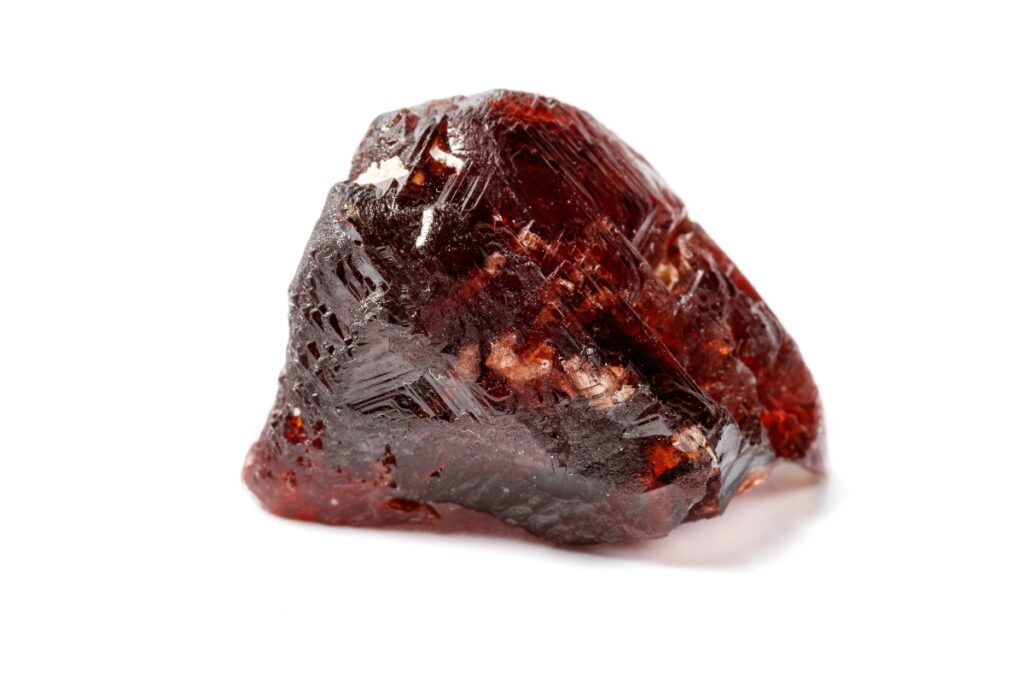
How to recognize it: Glassy, rounded crystals with many flat faces, usually deep red to orange.
Montana garnets are mostly almandine in bright red, orange-red, pink or violet-red, and some are gem quality.
| Location | GPS Coordinates |
|---|---|
| Ruby Reservoir (BLM) | 45.2263, -112.1188 |
| American Bar (Helena National Forest — check for mining claims) | 46.813034, -111.929179 |
The Ruby River drainage and Alder Gulch near Virginia City are the richest garnet areas, and Ruby Reservoir is the easiest public spot. Garnets also turn up in the Missouri River gravels near Helena, including Spokane Bar, elsewhere in Lewis and Clark County and at Pole Creek.
Most Montana garnets are small, but a few are clean enough to facet. To shape your finds, see how to cut and polish garnets.


Opal
How to recognize it: Glassy to waxy and softer than quartz; precious opal flashes rainbow colors as you turn it, while common opal is milky or translucent without that play of color.
Montana opal is mostly common opal, including clear hyalite, moss opal and opalized wood, rather than precious opal with a play of color.
| Location | GPS Coordinates |
|---|---|
| Mount Blackmore (Custer Gallatin National Forest — wilderness study area) | 45.443916, -111.003301 |
Mount Blackmore and the surrounding Gallatin National Forest are the best-known opal areas, and hyalite is found in the rock slides below Hyalite Peak. Opal is also reported from Glendive, Frying Pan Basin and Lodgepole Creek in Beaverhead County.


Gold
How to recognize it: Heavy, soft and bendable, and it stays bright yellow even in shade, unlike glittering pyrite.
Montana is the Treasure State, and it produced about 17.75 million ounces of gold between 1862 and 1965.
Fifty-four districts each produced more than 10,000 ounces, and Butte, Helena, Marysville and Virginia City each produced more than a million. Gold is found in the creeks of the Radersburg area east of the Elkhorn Mountains and in the Jardine District north of Yellowstone National Park.
Many locations around Cooke City are rich in gold, and the Kendall and North Moccasin districts are historic areas in central Montana. For panning, try the Missouri, Big Hole, Bitterroot, Clark Fork, Boulder, Yaak and Blackfoot rivers.
Panning needs no permit on national forest land, and metal detecting is allowed on most public land, but FWP sites require written permission for a detector. A sluice box needs a Notice of Intent on national forest land; learn how to use a sluice box properly. For the best sites and laws, see our guide to gold prospecting in Montana.


Tourmaline
How to recognize it: Long crystals with lengthwise grooves and a rounded triangular cross-section; black is most common, pink and green are the prized colors.
Montana tourmaline is usually dark, from large blocks to smaller crystals.
| Location | GPS Coordinates |
|---|---|
| Delmoe Lake (Beaverhead-Deerlodge National Forest — check land status) | 45.990159, -112.356928 |
Tourmaline is abundant in the pegmatites of southwest Montana. Look in Beaverhead County at the Jahnke Mine, the Calvert Hill Mining District and the Ruby Range, at Timber Butte near Butte, at the Golden Eagle Mine in Granite County and at Toll Mountain in Jefferson County.
Other areas include the Elkhorn and Helena mining districts, Montana City, Mill Canyon and elsewhere in Lewis and Clark County. Mindat lists many more Montana tourmaline localities.
Other Notable Rocks & Minerals in Montana


Montana has many more rocks and minerals than the ten above, but the ones below are rare, hard to reach or found only in mines that are closed to collectors.
Kimberlite, a dark gray to black, rough-textured igneous rock that can carry diamonds, occurs in Montana mainly as diatremes with kimberlitic affinities in the Missouri River Breaks of north-central Montana. Diamonds have been reported from the Missouri Breaks, Grassrange, Yellow Water Butte, Porcupine Dome, the Sweet Grass Hills, Blaine and Hill counties and Grasshopper Creek, but no commercial diamond mine has been developed.
The best-known Montana diamond is the 14-carat Lewis and Clark Diamond, found in 1990 near Craig. Finding one yourself is extremely unlikely.
Rubies occur with sapphires in the Rock Creek district, and red sapphires turn up in the Spokane Bar gravel, but both are rare. Rubies have also been reported from Granite County, Yogo Gulch, the Red Rock Mine and the Missouri River.
Topaz, clear, yellow or golden, is a rarer find in the Spokane Bar gravels and occurs in the Boulder Batholith around Delmoe Lake and Strawberry Butte, at the Berkeley Pit, in East Helena and at Eldorado Bar. To learn where topaz forms, see where to find topaz.
The Butte Mining District is famous for pink rhodochrosite and rhodonite from the Emma, Badger and Parnell mines and Walkerville, along with chalcopyrite, bornite, barite and calcite. Rhodochrosite is also reported from Beaverhead County, and pink-and-black rhodonite from Park County. Most of these minerals come from underground veins in closed mines, and turquoise from the Berkeley Pit is not available to collectors either.
Geodes are not widespread in Montana, but they are reported from the Pryor Mountains, Bear Canyon and elsewhere in Carbon County, Crystal Park, the Butte District and around Billings, filled with quartz, agate or pyrite. Other minerals reported from Montana include jade, chromite, chalcedony, corundum, staurolite, serpentine, silver, copper, covellite, fluorite, sphalerite, aquamarine, beryl and onyx.
State Gem Stones & Fossil of Montana
Montana has two official state gem stones and a state fossil, but no official state rock or mineral. Each symbol and the year it was designated is listed here.
| Category | Symbol | Year |
|---|---|---|
| State gem stone | Sapphire | 1969 |
| State gem stone | Montana agate | 1969 |
| State fossil | Maiasaura peeblesorum (duck-billed dinosaur) | 1985 |
The Montana Council of Rock and Mineral Clubs asked the legislature to name sapphire and Montana agate as state gem stones. Maiasaura fossils have so far been found only in Montana.
Nests with baby Maiasaura bones and eggshells, found in 1978 in the Willow Creek Anticline of northwestern Montana, showed that these duck-billed dinosaurs nested in groups and cared for their young. The nearby Egg Mountain site later revealed eggs and embryos of small, bird-like dinosaurs.
Gold Prospecting Clubs in Montana
Gold is so widespread in Montana that the state has several prospecting clubs, and joining one is the fastest way to learn a stretch of creek. Most are chapters of the Gold Prospectors Association of America (GPAA).
- Central Montana Prospectors — the Great Falls chapter of the GPAA, covering gold panning, metal detecting, rockhounding and fossil hunting.
- Headwaters Chapter of the GPAA — based in Belgrade and serving southwest Montana, with monthly meetings open to all experience levels.
- Blackfoot River Chapter of the GPAA — based in Lincoln, in the Blackfoot Valley.
- Northwest Montana Gold Prospectors — a club in the Libby area of northwest Montana.
- Yellowstone Prospectors — the Billings branch of the Yellowstone River Prospecting Club.
If you are new to prospecting in Montana, a club outing is the easiest way to learn which ground is open. Contact the club before you visit, as meeting times and places change.
Recommended Rockhounding Gear
While special gear is not required to find nice rocks and fossils, having the right tools will help you find more than what’s simply laying around on the open ground. Here are some of the more basic tools and safety gear for interested rockhounds.
Geological Hammer
This 22oz Pointed-Tip Rock Pick by Estwing (Amazon link) is recommended for its durability and shock-reducing grip.
A rock pick is essential when collecting mineral specimens from a hard substrate such as stone. The pick’s handle is shock-resistant, making it more comfortable for use for longer times in the field.
Geology Pick
The Geology pick by Estwing (Amazon link) is a good choice for those starting out in the hobby as well as seasoned professionals.
The hammer comes with a pointed tip on one side of the head and a chiseled end on the other. This pick is good for excavating interesting mineral and fossil specimens.
Mini Shovel
The Mini D-Handle Round Point Shovel by Stanley (Amazon link) pairs convenience with durability. Especially in areas of soft material such as sand or clay, it is nice to have a sturdy shovel that is easy to carry.
The D-shaped handle gives you more leverage when digging on your knees, which is something that similarly sized standard-handled shovels wouldn’t provide.
Heavy Duty Work Gloves by Ironclad
Working with your hands in rockhounding environments can be rough; it is easy to get cuts or abrasions when in the field. Protecting your hands is important, especially while working with sharp or abrasive rocks.
The Heavy Duty Work Gloves by Ironclad (Amazon link) protect your hands from sharp rocks and tools. They are machine washable, highly abrasion resistant, and durable.
Safety Glasses
Eye protection is a must when breaking up a rock or any sort of work where debris could cause injury to your eyes.
The 3M Safety Glasses (Amazon link) are anti-fog and have a corded earplug system, as well as a removable foam gasket. The clear, scratch-resistant lenses shield the eyes against harmful ultraviolet light as well as prevent eye injury from flying rock chips.
First Aid Kit
With its 299 pieces, the Only Emergency First Aid Kit (Amazon link) is a good one for rockhounds. Of course, it’s best to avoid injuring yourself but if things go wrong it’s good to be prepared.
Some of the items found in the kit include fabric and plastic bandages, painkillers, gauze and pads, cold packs, wound closers, and many more.
FAQ About Rockhounding in Montana
These are the questions that come up most often when planning a Montana rockhounding trip.
Do I need a permit to collect rocks in Montana?
Not for casual, personal collecting with hand tools on national forest or BLM land. You need a free permit for petrified wood on national forests, including the Gallatin Petrified Forest, and a research permit for any vertebrate fossil, while state parks, state trust land and national parks do not allow collecting.
Is panning for gold legal in Montana?
Yes, and on national forest land it needs no permit. A small sluice box needs a Notice of Intent, a suction dredge needs Forest Service approval plus DEQ and DNRC permits, and wilderness areas, Wild and Scenic River corridors and other people’s claims are off-limits.
Can you still find gold in Montana?
Yes, mostly by panning the rivers and creeks of the old placer districts such as the Missouri, Blackfoot and Clark Fork rivers. Joining a prospecting club is one of the best ways to find productive ground.
Where can you find dinosaur fossils in Montana?
The badlands of eastern Montana, around Miles City and Glendive, are world-famous for dinosaur fossils, and museums there display them. Dinosaur bones are vertebrate fossils, so you can look at them but not collect them on public land without a research permit.
Does Montana have a state rock?
No, Montana has no official state rock or state mineral. Its official state gem stones are sapphire and Montana agate, both designated in 1969.
What rare rocks can you find in Montana?
Montana moss agate and dryhead agate are the most sought-after, along with wonderstone, serpentine, opalized wood and kimberlite. The Pryor Mountains, the Yellowstone River, Mount Blackmore and the Missouri River are good places to start.
What rare minerals can you find in Montana?
Rubies, diamonds, topaz, rhodochrosite, rhodonite, turquoise, aquamarine and beryl all occur in Montana, but most are rare finds or come from closed mines. Diamonds are the rarest, and the 14-carat Lewis and Clark Diamond, found in 1990, is the best-known example.
What is the most famous rock or mineral found in Montana?
Sapphire, which comes in blue, green and white and is one of the two state gem stones. Pay-to-dig sites such as Gem Mountain near Philipsburg and Spokane Bar near Helena let anyone search for them.
Conclusion
Montana rewards two very different kinds of trip: crystal and sapphire digging in the mineralized southwest, and agate and fossil hunting along the eastern rivers and badlands. The digs at Crystal Park, Gem Mountain and Spokane Bar make an easy day out in between.
Check land status before you dig, get the free permit before you collect petrified wood in the Gallatin Range, and leave dinosaur bones where you find them. If you are flying home with your finds, read whether you can take rocks on a plane.
Before you head out, check our list of all the tools you need for rockhounding, including a good rock hammer. If you are interested in checking out the best rockhounding tools, you can find them by clicking here (Amazon link).
| Research Behind This Guide |
|---|
This guide was compiled and edited by the How to Find Rocks team. It consolidates, fact-checks, and builds on original research and field reporting first published on this site by the following subject-matter expert(s): Lauren Ballejos — Rockhounding enthusiast, member of the Flagg Mineral Foundation (FMF), and professional content writer with a growing personal rock collection. See all articles by Lauren → |