As an Amazon Associate, I earn from qualifying purchases with no additional costs for you.


Jasper is an opaque, cryptocrystalline (microscopically fine-grained) variety of quartz, hardness 7 on the Mohs scale, that does not transmit light even in thin slices. It forms in volcanic and sedimentary environments worldwide, most commonly in red, brown, yellow, or black — though rare varieties like ocean, bumblebee, and dalmatian jasper show striking color combinations.
Price: a plain tumbled stone runs $5-10; rare varieties like bumblebee or ocean jasper can reach $100-300. Best U.S. states: Oregon, Arizona, California, and Washington — check beach gravels, riverbeds, and agate beds. Quick ID check: real jasper is fully opaque (no light passes through) and a knife cannot scratch it.
What Is Jasper, and How Does It Form
Jasper is an opaque variety of chalcedony — cryptocrystalline quartz, meaning its quartz crystals are so small they’re invisible even under a magnifying loupe. That’s what gives jasper its signature matte, non-transparent look, unlike its close cousin agate, which shares the same mineral family but stays at least partly translucent.
Raw, unpolished jasper from a beach or riverbank looks dull and matte. Once cut and polished, the same stone develops a glassy luster that reveals its full color and pattern.
Jasper isn’t a single mineral in the strict sense — it lacks the ordered crystal structure required for that classification. Instead, it’s an aggregate: mostly cryptocrystalline quartz, colored by mineral impurities that get trapped in the silica as it forms. Geologically, it forms through a few distinct processes:
- Contact-alteration of radiolarite mud in metamorphic rock, producing ribbon-like banded jaspers
- Replacement of limestones and marbles by silica-rich fluids
- Association with quartzites and hornfels
- Compact colored chalcedony forming within agate nodules
In broad terms, jasper forms wherever silica-rich rock undergoes metamorphism, or where silica-saturated fluids solidify in pores and veins — commonly in areas with a history of volcanic activity.
The specific color of a jasper sample comes down to which trace minerals were present during that process. The table below summarizes the most common pairings.
| Jasper color | Mineral impurity that causes it |
|---|---|
| Red, pink | hematite, garnet |
| Brown | goethite, hematite |
| Yellow | goethite |
| Black | magnetite, Mn-oxides |
| Green | chlorite, epidote, actinolite |
| Blue, violet | magnetite, glaucophane-riebeckite, hematite |
| Gray | albite, K-feldspar, sericite |
The Main Types of Jasper

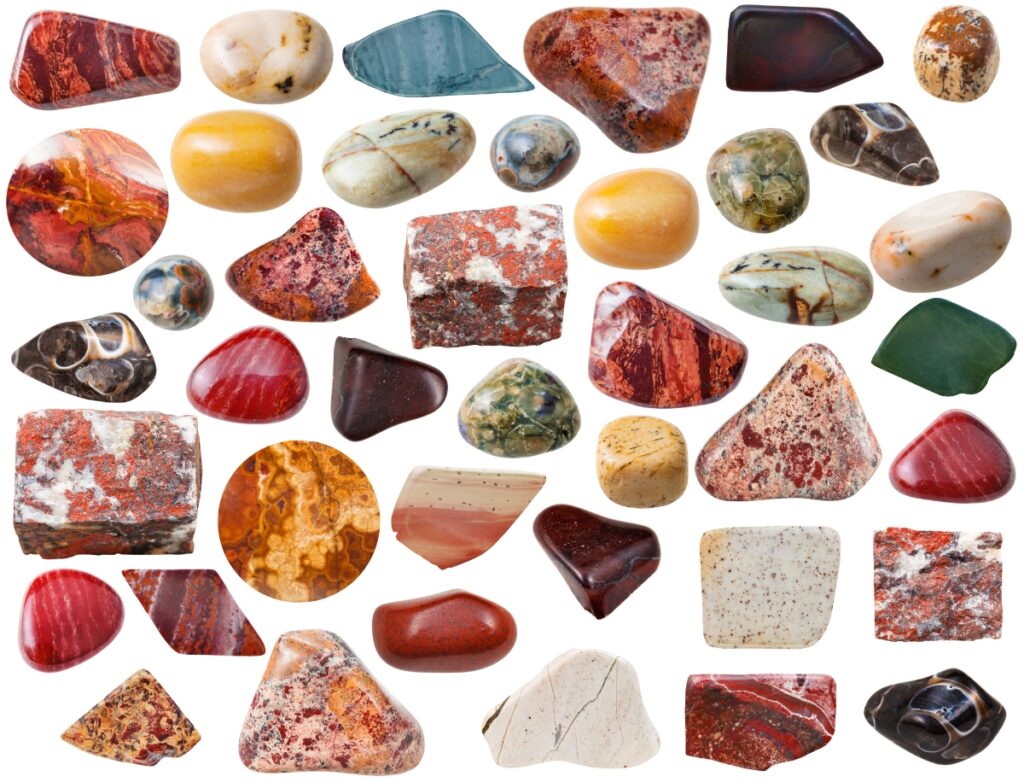
Jasper’s color-and-texture combinations are effectively uncountable, which is part of why it has so many trade names. A few varieties come up again and again — and several of the most famous “jaspers” aren’t mineralogically jasper at all.
- Red jasper — the most common and widely available type, found on beaches and riverbanks worldwide.
- Bloodstone jasper — dark green background with red-to-brownish flecks from iron oxide, historically associated with religious imagery.
- Bumblebee jasper — vivid yellow-orange tangled with black. Mined mainly in Indonesia; scientifically it’s a carbonate-rich volcanic rock, not true jasper, but it’s traded under the name because of its opaque, patterned look.
- Dalmatian jasper — black-and-white, resembling the dog breed’s coat. Mineralogically a peralkaline rock (feldspar, quartz, amphiboles), not true jasper either.
- Ocean jasper — green spherical aggregates on a white or beige background, from Madagascar; one of the more valuable varieties.
- Poppy jasper — intense red spherical aggregates that resemble poppy flowers, found notably around San Jose, California.
Jasper’s main practical use is decorative and lapidary — beads, cabochons, cameos, small carved objects, and jewelry settings. Because it’s hard (Mohs 7) and takes a good polish, it holds up well to everyday wear.
When iron content is high enough to be economically significant, iron-rich jasper is mined as a low-grade iron ore called jaspilite — a reminder that the same iron oxides that color the stone are, at industrial scale, the reason it’s valuable for something else entirely.
How to Identify Real Jasper (Step by Step)
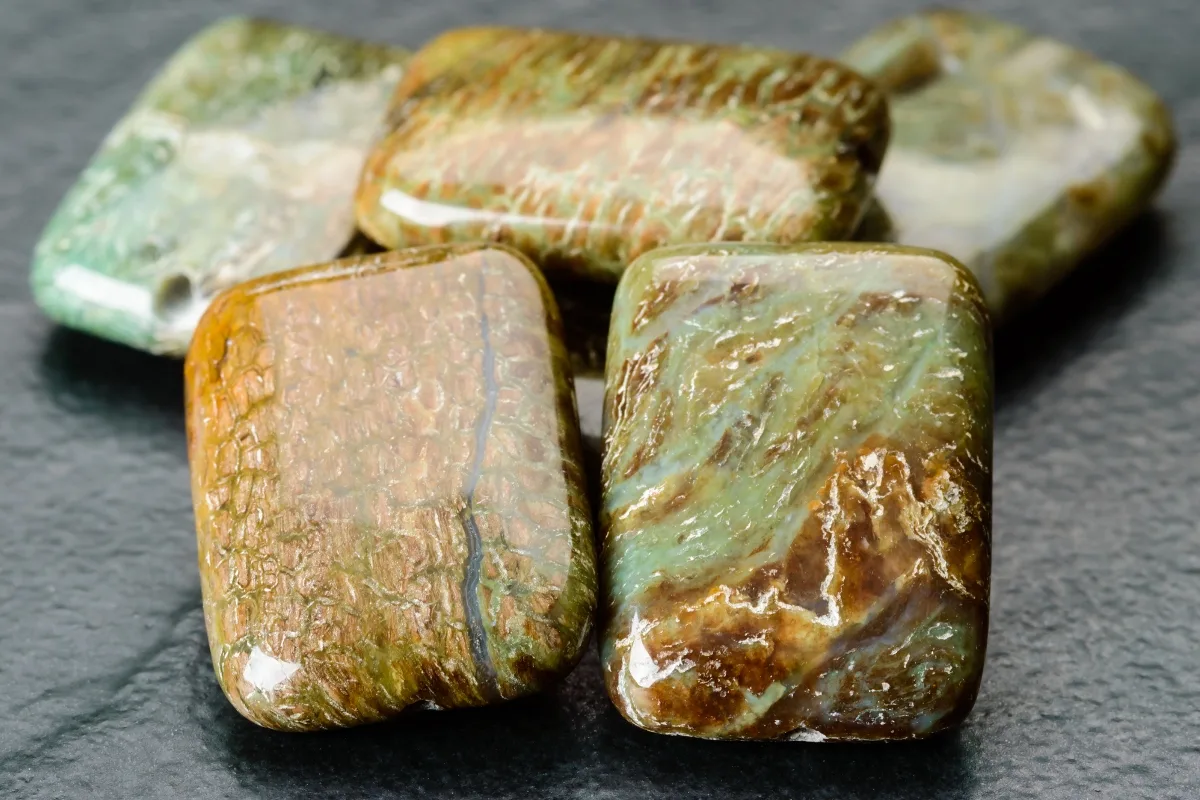
Jasper identification comes down to two physical properties: opacity and hardness. Unlike many gemstones, you don’t need lab equipment — a flashlight, a loupe, and a knife blade will get you a reliable answer in a few minutes.
- Preparation — a naturally tumbled beach or river stone isn’t ideal for testing; if possible, examine a freshly broken surface.
- Grain size — look at the surface under good light, ideally with a hand loupe. If you can see individual quartz grains, it’s likely quartzite or sandstone, not jasper. True jasper is cryptocrystalline — no visible grains even under magnification.
- Opacity test — hold a flashlight behind the stone (or against a thin edge or chip). Real jasper is completely opaque and blocks all light. If any light passes through, it’s likely agate, carnelian, or chalcedony instead.
- Hardness test — try to scratch the surface with a steel knife blade or a piece of glass. Real jasper (hardness 7) cannot be scratched by either. Plastic fakes are much softer and scratch easily.
- Hot needle test (for suspected plastic fakes) — touch a heated needle to an inconspicuous spot. Plastic will melt and release an odor; real jasper will not react.


BTW: Do you want to know more about rock and mineral identification? The books listed below are the best ones you can find on the internet (Amazon links):
- Smithsonian Handbooks: Rocks & Minerals
- Gemstone & Crystal Properties (Quick Study Home)
- Ultimate Explorer Field Guide: Rocks and Minerals (National Geographic Kids)
Real vs. Fake Jasper


Because jasper is so widespread, outright fakes are relatively rare compared to more expensive gemstones — but two situations come up often enough to be worth knowing.
- Other natural chalcedony varieties (agate, carnelian, onyx) are sometimes sold under the jasper name, whether by mistake or deliberately, since all three share the same quartz family and similar patterns.
- Dyed low-quality jasper or dyed agate shows up in unnaturally saturated colors that real jasper never produces on its own.
The table below summarizes how to tell them apart.
| Feature | Real jasper | Fake jasper |
|---|---|---|
| Transparency | Completely opaque | Agate/chalcedony fakes are semi-translucent; plastic fakes are opaque |
| Hardness | 7 on the Mohs scale — a knife or glass cannot scratch it | Plastic fakes are much softer and scratch easily |
| Color | Natural tones: red, brown, gray, yellow, orange, rarely green or white | Unnaturally vivid colors — acid purple, bright green, glowing blue |
| Trade names | Many legitimate trade names (bumblebee, dalmatian, ocean…) | Unfamiliar or invented trade names |
If you’re buying rather than hunting, jasper is generally safe to purchase on platforms like Amazon or Etsy as long as you avoid unnaturally bright colors. Buying rough, unpolished material rather than already-tumbled stones or finished beads also reduces the risk of picking up a dyed or fully synthetic piece, since dye and plastic are easiest to disguise once a stone is already cut and shined.


What Is Jasper Worth

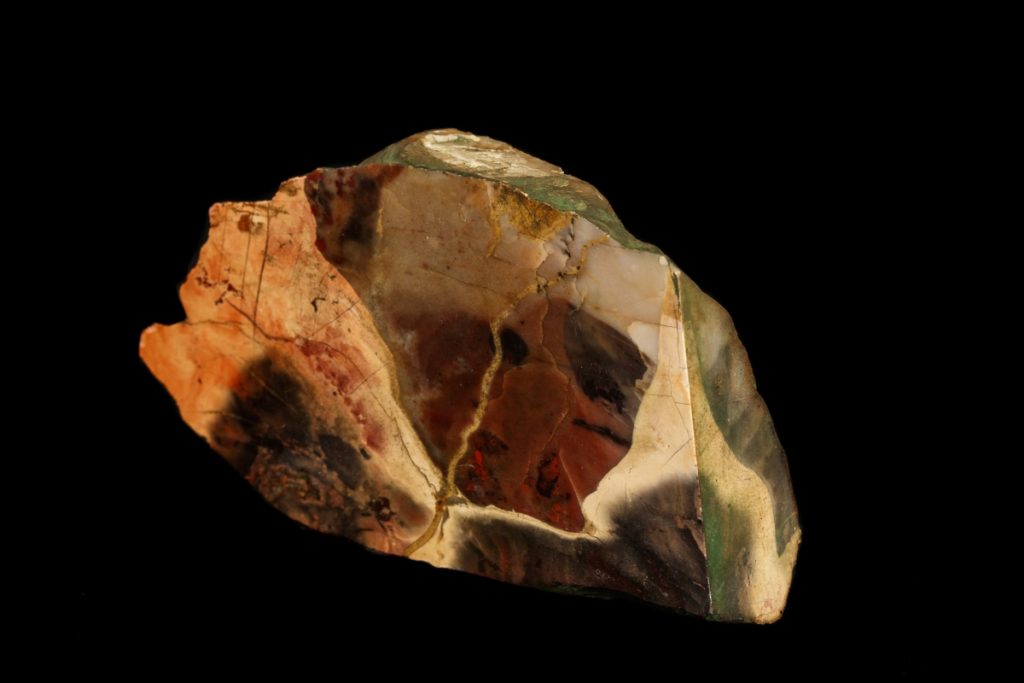
Jasper is one of the more affordable gemstones day-to-day — a plain tumbled stone rarely costs more than a few dollars. What changes the price dramatically is texture and pattern rather than clarity, since jasper is always opaque.
| Unit | Typical price |
|---|---|
| per carat | ~$0.5 (rare varieties) |
| per gram | $0.02 – $0.05 |
| per ounce | $0.56 – $1.41 |
| per pound | $10 – $23 |
| per kilo (rough material) | $20 – $50 |
Broken down by variety, the price range is even wider — this is where the value factors below really show up.
| Jasper type / color | Price per tumbled stone (3-10 cm) |
|---|---|
| Red | $5 – $10 |
| Green / black | $5 – $10 |
| Leopard skin | $10 – $20 |
| Bumblebee | $10 – $30 (exceptional pieces $100-300) |
| Poppy | $10 – $30 |
| Mookaite | $25 – $50 |
| Ocean jasper | $60 – $80 |
Four factors drive that spread:
- Color — the more saturated and contrasting, the higher the value; muddy or brownish tones are worth the least.
- Texture — evenly distributed spots or gently curved bands (as in dalmatian jasper) beat irregular, patchy coloring.
- Landscape pattern — jasper is unique among gemstones in sometimes resembling mountains, coastlines, or forests purely by chance. This is a matter of individual perception rather than a table you can look up, and the most striking examples can reach thousands of dollars.
- Craftsmanship — when a skilled cutter emphasizes a natural resemblance (to an animal, a face, a scene) with careful carving, that work adds significant value on top of the raw material.


Where to Find Jasper in the U.S.

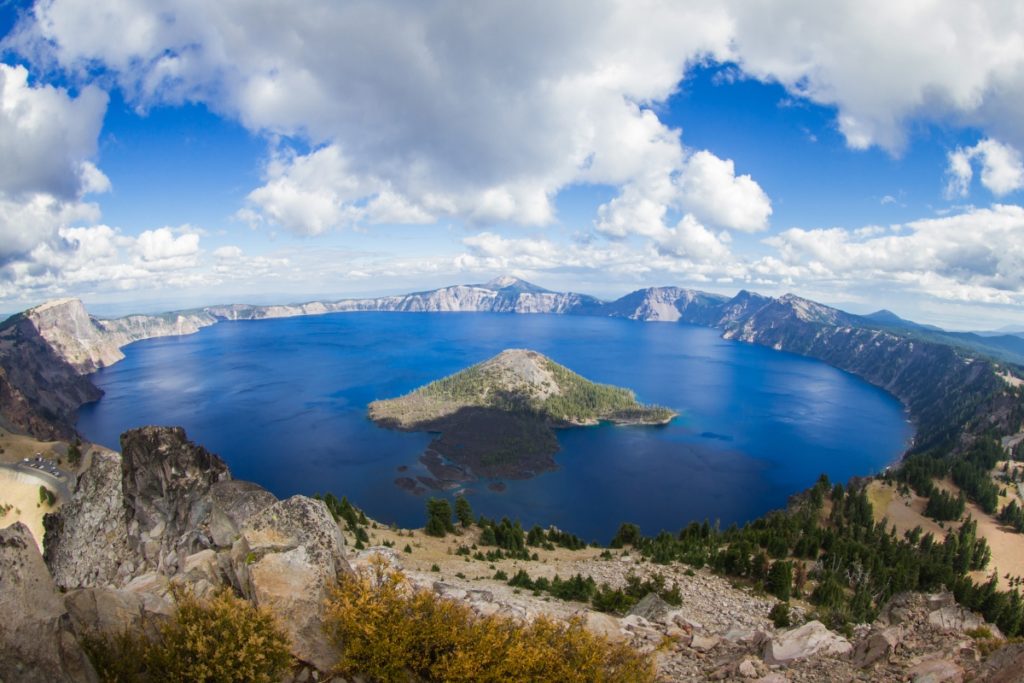
Jasper concentrates in a few kinds of terrain:
- Beach and ocean gravels, especially near river mouths and in regions with a history of volcanic activity
- Riverbeds and running streams that have collected and redistributed rock for centuries
- Some national park lakeshores (check collecting rules before you take anything)
- Agate beds — since jasper and agate form under similar conditions, wherever you find one, it’s worth checking for the other
Bring water to rinse dust off a candidate stone so you can actually see its color, along with a rock pick, eye protection, and a sturdy bag.
Recommendation box: All tools and equipment you need for rockhounding and rock identification* (Amazon links):
1. Estwing Rock Hammer – Light, comfortable, and extremely durable hammer.
2. Estwing Geologist Pick – Classic and the most trusted paleo pick in the world.
3. Finder 12-inch Chisels – Heavy-duty chisels set with hand protection.
4. Mini Handle Shovel – This is a great tool for digging deep in the dirt.
5 Ironclad Utility Work Gloves – Breathable, but they also protect the areas requiring them most.
6. 3M Safety Glasses – Comfortable and efficient goggles for rockhounding.
7. Convoy 8+ UV Light – 365nm UV LED flashlight with a patented glass filter.
8. Wesley’s Jewelers Loupe – High magnification options (30X and 60X) with carrying case.
9. Mohs Hardness Kit – A specially designed kit for rockhounds
*All recommended products are personally tested and regularly used by experts from this website.


Oregon, Arizona, California, and Washington consistently produce the widest variety and best quality. Here’s where to start in each.
| State | Specific areas |
|---|---|
| Oregon | Shores of Ochoco Reservoir (Ochoco jasper), Crater Lake National Park area (Crater Lake Flower jasper), Yachats-Florence beach gravels (orbicular jasper) |
| Arizona | Cave Creek and the hills west of it (red jasper), Foothills of Sunset Peak, Clifton (rare blue/black jasper), the York area and the Morristown-Castle Hot Springs road |
| California | Crescent City ocean beaches, Patrick’s Point State Park, Trinity River gravels, San Jose creeks northwest of Morgan Hill (poppy jasper), San Bernardino County (Amboy Crater, Afton Canyon, Lavic jasper near Midway) |
| Washington | Dungeness river gravels (orbicular jasper), Sappho and the Sol Duc River, Aberdeen beaches and streams (flower jasper), Lucas Creek |
Two practical notes worth flagging separately. Red jasper holds up well in water — unlike softer stones that lose color or dissolve, it’s commonly found directly in creek gravels, so don’t limit your search to dry banks.
And if you come across zebra jasper or yellow jasper while searching internationally sourced material, know that neither is a U.S. native: zebra jasper is mined mainly in Russia, Africa, and India (originally described from Western Australia), while yellow jasper turns up in South Africa, Russia, India, and Venezuela in addition to the U.S.
Frequently Asked Questions
Is jasper a mineral or a rock?
Technically neither in the strict sense — jasper is an aggregate, mostly cryptocrystalline quartz with mineral impurities. It lacks the ordered crystal structure required to be classified as a true mineral, but it’s commonly called a gemstone.
Can red jasper be found in water?
Yes — red jasper is commonly found in creek beds and gravels (for example, at Cave Creek, Arizona) and is resilient enough to withstand prolonged water exposure without losing color.
Where is bumblebee jasper from?
Bumblebee jasper is mined primarily in Indonesia; despite the name, it is mineralogically a carbonate-rich volcanic rock, not true jasper.
Is dalmatian jasper real jasper?
Not in the strict mineralogical sense — it’s a peralkaline rock composed of feldspar, quartz, and amphiboles. It’s traded as “jasper” because of its opaque, patterned appearance.
| Research Behind This Guide |
|---|
This guide was compiled and edited by the How to Find Rocks team. It consolidates, fact-checks, and builds on original research and field reporting first published on this site by the following subject-matter expert: Olena Rybnikova — Ph.D. candidate in Mineralogy and GIA Applied Jewelry Professional, with published research on the peer-reviewed portal Scopus. See all articles by Olena → |